Shaping the Future of CPHC® Training: Have Your Voice Heard!
Phius Educational Content Manager Sarah Klinetob Lowe shares updates on the curriculum development process for Phius Certified Consultant training, including a call for input from existing CPHCs.
In 2008, Phius Co-Founder and Co-Executive Director Katrin Klingenberg conducted the first-ever Phius Certified Consultant (CPHC®) training in the United States with 23 students in the class.
Fast forward to 2026, Phius now has more than 1,700 active CPHCs, each leading project teams toward certification of 651 total Phius Certified projects, totaling 10.7 million square feet and more than 10,300 dwelling units as of this blog’s publishing.
Each of our CPHCs have played an important role in transforming what was once a “proof of concept” to what is now “proof of scale.” Phius is now digging into the question: what do each of these CPHCs have in common? Answering this question will help Phius align future CPHC training with the latest duties, tasks, skills and knowledge required of today’s CPHCs to continue this momentous work around the world.
While we have started the process, we now need to hear from all active CPHCs to review and validate this work. Read on to learn more about this process and how you can get your voice heard.
A DACUM is a structured and collaborative process to distill the essential duties, tasks, skills and knowledge required of a specific role. To ensure both completeness and neutrality, a third-party facilitator works directly with the professionals who are currently performing that role, rather than directly with Phius staff.
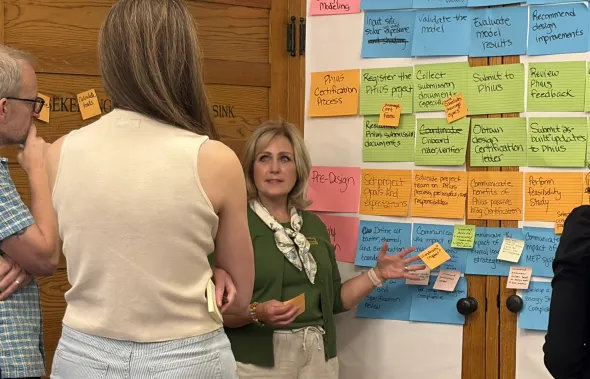
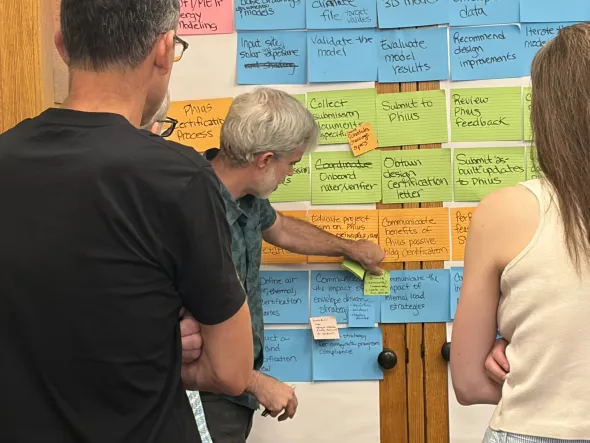
The first part of the DACUM process is a two-day in-person workshop with guest expert CPHCs to develop a draft chart of duties, tasks, skills and knowledge. This workshop took place July 22-23, 2026 in Chicago.
The second part is sending that draft chart and validation survey to all active CPHCs to review and validate this work (more on this later).
The outcome is a final chart developed and validated by the very people doing this work, allowing Phius to align our curriculum with essential duties, tasks, skills and knowledge and ensure future CPHC training is grounded and relevant to the industry.
“I greatly appreciate Phius engaging with Terri [Johnson] and WIDS for this work,” participant and Phius CPHC Tom Bassett-Dilley said. “With a growing field of CPHCs, growing demand, an evolving field, and many Certified projects to draw from, this was an important step to assessing the work we do and understanding how it can be best taught.”
Who was involved in the workshop?
Per guidance from Terri Johnson, Associate Director of WIDS and our workshop facilitator, guest expert CPHCs for the two-day in-person workshop were identified based on the following criteria:
Recognized by peers as experts/high-performing CPHCs
3+ years of experience across all major job duties of a CPHC
Broad representation of the industry, e.g.
Firm size
Geographic region(s) served
Type(s) of buildings worked on (single-family, multifamily, commercial, etc.)
Do not have any other current role with Phius (trainers, board members, staff members, etc.)
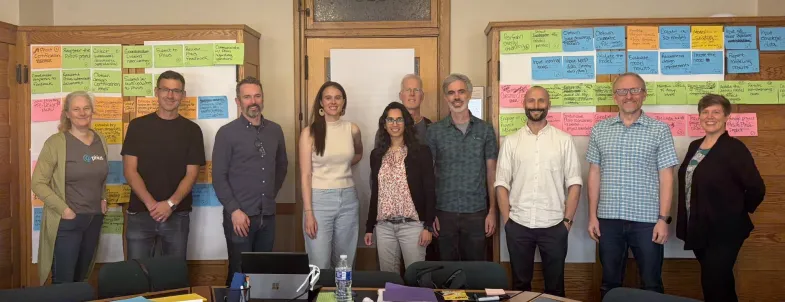
While it was a challenge to narrow down the long list of rockstars in our industry, the final list of guest expert CPHCs called on to do this initial work were:
Andy Allwine, RA, CPHC | Senior Associate of Passive to Positive (Lancaster, Pennsylvania)
Tom Bassett-Dilley, CPHC, FAIA, LFA | President of TBDA, LTD (Oak Park, Illinois)
Britt L. Clark, CPHC, CPHB, NCIDQ, LEED Green Associate | Senior Architectural Green Building Consultant of Sustainable Comfort (Worcester, Massachusetts)
Trey Farmer, AIA, CPHC, LEED AP | Principal and Partner of Forge Craft (Austin, Texas)
Jeff Geisinger, CPHC, AIA | Director of Sustainable Design of Utile (Boston, Massachusetts)
Maciej Konieczny, CPHC, CPHB | Director of Building Technologies of New Ecology (Boston, Massachusetts)
Cheryl Saldanha, PE, CPHC | Associate Principal, Building Science Practice Lead of Simpson Gumpertz and Heger (New York, New York)
Scott Yribar, AIA, CPHC | Architect at Vy Architecture (Boise, Idaho)
“It was a privilege to be part of the DACUM process and collaborate with such a thoughtful group of CPHCs,” Britt L. Clark said. “I left even more appreciative of a community committed to sharing knowledge, supporting one another, and continually improving how we prepare the next generation of consultants.”
Jeff Geisinger added, "I think the best part of the workshop was getting to collaborate with some of the most dedicated and knowledgeable Phius professionals I know! It was also a chance to step back and reflect on the critical role we play in designing passive buildings. Thank you to Phius for inviting me and to Terri Johnson for facilitating this process!"
How did the workshop work?
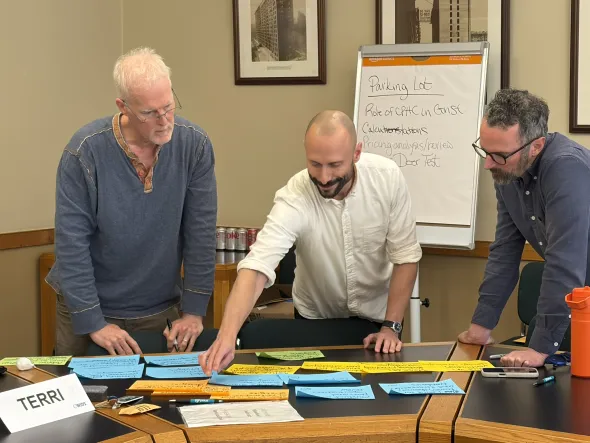
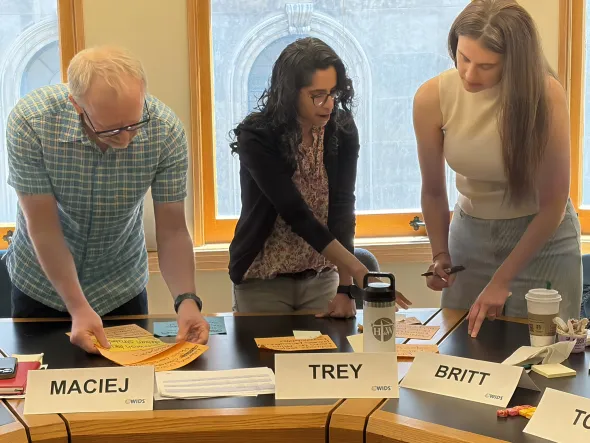
On the first day of the workshop, Terri led the group of guest expert CPHCs through identifying primary duties, associated core tasks and occupational trends. On the second day, the group added additional tasks, sequenced the tasks within each primary duty, identified the knowledge needed to complete each task, listed equipment and tools used on the job, and shared attitudes and traits needed to be a successful CPHC.
“The DACUM workshop was a meaningful opportunity to collaborate and reflect on what high-quality, relevant training needs to look like for the passive building field,” Cheryl Saldanha said. “I enjoyed the thoughtful discussion around how future consultants can be better prepared with practical, community-informed learning.”
Throughout the workshop, the guest expert CPHCs fully cleared their schedules and stayed dedicated, focused, and engaged to ensure a complete chart was produced by the end of the second day. (Kat, Lisa and I were there only to observe — a hard job in and of itself!).
I’m a CPHC! How can I share my thoughts?
While the guest expert CPHCs created the initial draft chart, we now need all active CPHCs to check and validate their work. This check will come in the form of a survey sent to all active CPHCs via email in the next several weeks. Questions include:
Is there a task you do regularly that you think should be added?
How frequently do you perform each task as a CPHC? (This will help inform Phius of what tasks to emphasize in future trainings).
How difficult is each task for you to complete? (This will help inform Phius on the depth of knowledge to provide for each task in future trainings).
How important/critical is each task for being successful as a CPHC? (This will help inform Phius on both emphasis and depth for each task in future trainings).
The guest expert CPHCs will then review the survey findings in early September 2026 to finalize the document.
Thank you!
I’d like to extend a huge thank you to our entire community of CPHCs! We could not have achieved this tremendous upward progress without each and every one of you, and we look forward to hearing your voices in shaping the future of CPHC training through the survey.
And a very special thank you goes to our guest expert CPHCs for dedicating significant time and jumping “all in” to this process with us. It was astonishing how much you achieved in just two days, and we are grateful for you engaging so fully and deeply to create this initial body of work.