Sometimes change happens almost instantly, in a big disruptive way. But more often it is so slow and gradual you barely notice it.
When I started on the Phius path roughly 25 years ago, I was certain the necessity of what we were promoting would sell itself fast. I quickly learned otherwise from one of my mentors, Sam Rashkin. When I sat in his office and said “incrementalism is death,” he told me it is a marathon not a sprint. And boy, was he right.
Fast forward to today.
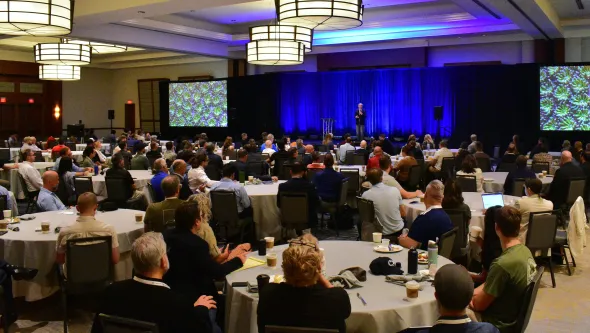
At the opening of PhiusCon 2026, I said I thought we might be standing at the beginning of Phius 3.0. I deliberately didn't define it. I hoped attendees would explore that proposition among themselves during the event.
Post conference, I want to share what I am beginning to see.
But first, I want to thank the speakers, exhibitors, sponsors and attendees who made PhiusCon 2026 such a uniquely valuable experience. Special thanks go to our newly formed Stakeholder Board Committee and the Phius Alliance leadership for helping us listen to our community.
One thing stood out from those conversations: this community doesn't need Phius simply to keep doing more projects. It needs us to make the processes easier, more affordable, and more reliable to deliver — at a much greater scale.
Phius 1.0 was invention. Could passive building work across North America's climatic and economic diversity? We proved it could.
Phius 2.0 was scaling. We built standards, software, training programs, certification processes and policy infrastructure.
New York showed us how to scale passive projects first with political will, and Massachusetts showed us how codes can transform an entire market.
Phius Certification Program Director James Ortega and his extraordinary certification team here at Phius handled a tsunami of projects during this scaling period while improving turnaround times and maintaining rigor.
We trained thousands of Phius Certified professionals to design, build and verify high-performance buildings. And now our Phius Trades Training is elevating those whose craftsmanship is absolutely crucial for scalable success.
Passive House Accelerator Director Zack Semke delivered an amazing, hopeful and inspirational opening keynote at PhiusCon 2026 on the power of exponential growth and learning that can lead to sudden positive changes. As an example, he invoked J.R.R. Tolkien and the Battle of Helm’s Deep, during which almost all hope was lost until Gandalf appeared leading an army down the hill on his horse.
I keep imagining Gandalf's army appearing on the hill — except it's an army of highly trained tradespeople, ready to build resilient communities for all.
Our Alliance membership is at an all-time high, and the Alliance is becoming the professional resource backbone we always envisioned. Our army of Phius professionals has designed, built, and tested buildings. Manufacturers have developed better products. Developers convinced other developers to go passive. Our community influenced programs and changed codes.
All this action thrust passive building into the mainstream, and something amazing happened.
Passive building stopped belonging to Phius. It became an ecosystem.
Zack presented a slide that talked about the moment in time many millions and billions of moons ago, when a single cell swallowed the cell that could produce energy from the sun and refused to give it back. It integrated it into its own organism. Our community has done the same. It is now self-propelling and self-generative.
Conference attendees saw it right away with a sold-out trade show, sophisticated products and advanced presentations by design professionals. There were countless examples of businesses investing and vertically integrating, policymakers creating markets in more places, and developers realizing the value of integrating the design process into their delivery systems. It’s an ecosystem in action.
And that means our job changes again.
Phius 3.0 cannot simply be a bigger version of Phius 2.0.
For 20 years, we thought we were developing better, optimized energy-efficient buildings on the path to zero. But we stumbled upon something much bigger.
We learned how to make buildings less dependent on the systems around them and resilient in the face of increasingly challenging climate conditions.
Less energy demand. Less vulnerability. More reliable comfort and safety.
That is the foundation of resilience on the building level, but it also creates systems resilience that benefits the larger energy system and offers value far beyond energy bills and passive survivability for communities, utilities, investors and insurers.
Phius 3.0 is about making that value accessible at scale by:
Making delivery simpler without compromising quality assurance
Building the workforce
Transforming and electrifying existing buildings and entire new communities, combining low load strategies and renewables
Helping capital markets recognize the value of resilience
Connecting passive and positive energy community designs with distributed energy systems and a changing grid
In order to do this, Phius itself has to become resilient.
For a long time, much of our institutional knowledge lived in a handful of people's heads.
This year, Mike Knezovich retired. Mike was the only Phius staff member besides me who knew the entire story of Phius, from the early days through all our growing pains. Thank you, Mike, for your service! It is safe to say that without your persistence, grit and commitment, zest and voice we might not be here today.
His retirement marks the end of an era, but also the beginning of another. The next generation that will lead Phius 3.0 has arrived.
Lisa White stepped into co-executive leadership at the end of 2024. Michael Franco has been promoted to Operations Director, and Max Lapthorne has been promoted to Communications Director.
Additionally, Nick Hurst, who some of you might know from his exceptional work at the EPA Indoor Air Plus Program, joined our team just before PhiusCon in a newly created role as Program Development Manager. He will work on creating a structured framework for innovation work done at Phius and manage coordinated delivery of new products and programs.
These changes represent a shift from an entrepreneurial organization driven by a few individuals to an institution with distributed leadership, clear responsibilities and reliable operations. And my role is changing, too.
For years, my job was pushing. Push the idea. Push the standards. Push the organization. Push the market. Sometimes push all of you.
But as I looked around at PhiusCon 2026, the ecosystem and next generation of leadership are here. My job is no longer to be the engine. It is to look toward the horizon.
What is coming that we cannot quite see yet? And what should we begin building now so that five or 10 years from now, we are once again ahead of the problem?
The future depends on what all of us see together. That is why your voice as our stakeholders matters so much. We built Phius together, and now we have to build what comes next together.
Phius 1.0 proved the idea.
Phius 2.0 built the infrastructure to scale it.
Phius 3.0 is about being ready for what comes next — together.