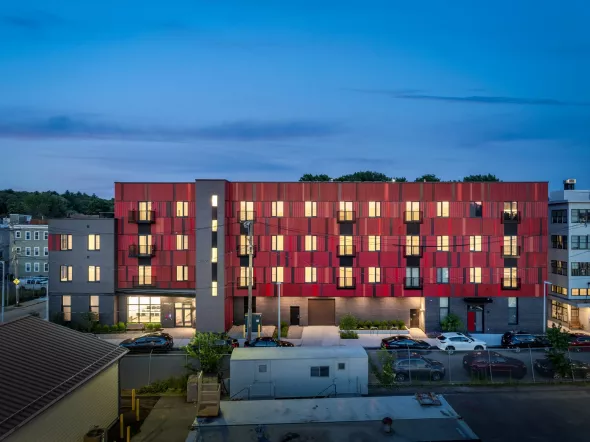
Onward and upward is a common refrain among Phius staff members. It’s an encouraging mantra with the built-in promise of progress, making it particularly apt when discussing the last year at Phius.
We have seen upward progress in all aspects of the organization, so with 2025 nearing its end we wanted to share details on some of that progress. Below is a look at key developments from the Project Certification, Training Curriculum Development, Policy and Product Certification departments, along with some goals for 2026.
Project Certification
From Phius Certification Program Director James Ortega
2025 was another productive year for the Phius Building Certification Team. Phius has now Certified 597 projects totaling 9.5 million square feet and more than 9,000 dwelling units all-time. Some exciting milestones from 2025 include:
January: Phius Certified its 500th project
May: Phius certified the 150th project in New York
June: Phius certified the 150th project in Massachusetts
August: Phius Design Certified its 1,000th project overall, its 100th project in 2025 and registered its 300th project in Massachusetts
September: All new projects are officially submitted under the Phius 2024 program
November: Phius Registered its 1,500th project and Certified its 100th project in 2025
December (as of 12/8): Phius is on pace to Certify its 600th project by the end of the year and has Design Certified a new record high 155 projects in a single year (previous record was 154 in 2023)
Phius’ incredible Building Certification Review team conducted a whopping 750+ Design Reviews and 250+ Final Reviews en route to the accomplishments noted above. That comes out to about three design reviews and one final review returned per business day. Phius also completed 26 feasibility studies for teams and clients who are new to passive building but interested in what the standard can offer.
We also saw a significant shift this year in the scale of projects being Certified. From 2019-2024, the median size of a Phius project was between 6,000-7,000 square feet. In 2025, that figure jumped to 25,000 square feet, driven almost entirely by the boom of large multifamily Phius projects in New York and Massachusetts. The median project size in those two states this year was 51,000 square feet compared to 3,300 square feet for all other states.
As passive building continues to gain traction throughout the country, Phius’ Building Certification Review team will continue to grow and work diligently to develop more resources for project teams to make the certification process as smooth as possible.
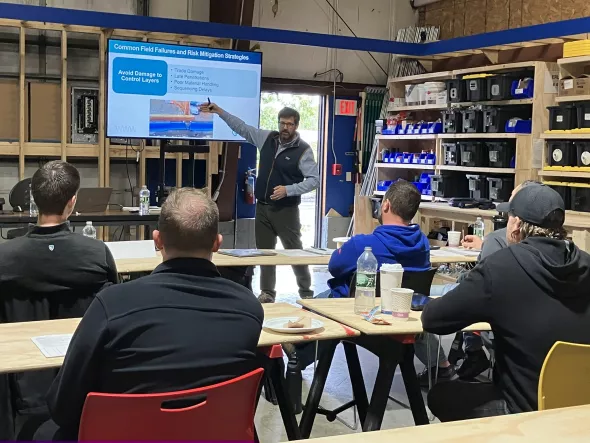
The Curriculum Development team (Lisa White, myself, John Loercher, Ryan Abendroth, Michael Franco, Lindsay Ahmed, and Natalie Wilson) has been hard at work this year! We’ve been making excellent progress on the Phius Certified Consultant (CPHC®) revamp and are well on track for a January 2026 launch. Special thank yous to Lisa for her phenomenal leadership and passing of the torch to me over the past few months, John for leading and developing the new instructor-led content and outlines for new self-paced WUFI Passive tutorial videos; Lindsay for leading, developing, and implementing both the online content Style Guide and WCAG accessibility compliance strategies; Rodrigo and Michael for recording and producing new self-paced WUFI Passive tutorial videos, and Josh and David for managing the transition process for currently registered CPHC students.
We have also launched a brand new Phius Certified Builder (CPHB) curriculum in collaboration with Alex Boetzel and Earth Advantage, including all new self-paced content, instructor-led content, online exam, and open-ended exam. Special thanks to Natalie, Lindsay, and Lisa for all their work to transform raw content into engaging modules, Michael for his quick and thorough development of the detailed student workbook, Josh for his work to ensure success of the pilot offerings and two exams, and all of our CPHB instructors for their invaluable input and for learning and teaching this brand new curriculum.
We have many vital projects ahead in 2026, including finishing out the CPHC and CPHB revamps and working with an external consultant to complete a CPHC job analysis. We’ll also be launching development of several specialty trainings on topics such as METr, feasibility studies, the Phius Prescriptive Path, and project certification. We’ll also be kicking off curriculum updates in line with the 2027 Standard release for CPHC, CPHB, and Rater/Verifier. Last, but certainly not least, we’ll continue the great progress we’ve been making on both project and program management for curriculum development.
We have an amazing team, and are looking forward to accomplishing even more great things together!
Work in 2025 generated several advances in Phius related policies. In addition, there are still a number of initiatives that are still being pursued. Finally, work has begun on setting up systems and engaging in research to give more structure to our work. Below is a list of successes, work from 2025 that will continue into 2026 and the research and structural work.
We also worked with New York Passive House to get an Alternative Compliance Path in the New York City energy code. We were ultimately unable to do so, but it was a main topic of conversation in many of the stakeholder meetings.
Continuing initiatives:
Working with the city of Arlington Virginia to establish a pilot program incentivizing Phius
Working with the city of Seattle on establishing Phius as the energy code in the city
Preliminary initiatives for next year:
Outreach to the state of Maryland as it looks to update its energy code
Working with the Ohio Home Financing Agency to include Phius in its upcoming Qualified Allocation Plan update
Research Work:
Worked with intern Sam Laminack and Zoe Rader to track and better understand the firms that are working on Phius projects (particularly in Massachusetts). This is to better understand how the market is responding to the significant uptick in projects in the state.
Started work on and will continue on tracking how policies are resulting in projects. The first step is to tie the incentive (if it exists) to finished projects i.e. whether there was Low Income Housing Tax Credit funding; utility funding or using the alternative compliance path
The Phius Window and Door Certification Program saw an unprecedented amount of interest and certification work in 2025. We added 100 certified windows and 83 doors to the database, and six new manufacturers certified products for the first time. Our team is currently booked out for Orange Path certification work through February 2026, and inquiries from both new and returning manufacturers for certification work remain at an all-time high.
In an effort to further improve our program, we intend to continue working toward adding a condensation resistance value to Phius Certified windows and doors. In a similar effort, we'll be collecting available impact resistance data from manufacturers as we continue to process renewals for existing certified products. Finally, we hope to use 2026 to pursue some additional optimizations to our database and certification processes to help keep our program running smoothly.