We’re excited to announce the launch of Phius’ new International QA/QC Path! For years, teams outside the United States who want to build to Phius standards have asked for a verification process better tailored to where they work. And now we are happy to deliver just that.
The Phius International QA/QC Path makes Phius Certification practical for single-family, multifamily, and commercial buildings worldwide, with initial launches in Canada and Japan set for 2027.
Project teams working outside the United States are not required to choose the International QA/QC Path, though it is recommended. Projects within the United States are not eligible to pursue the International QA/QC Path.
In this post, we’ll answer:
What is the International QA/QC Program?
Why did Phius create it?
How does the program benefit international projects?
What is the International QA/QC Path?
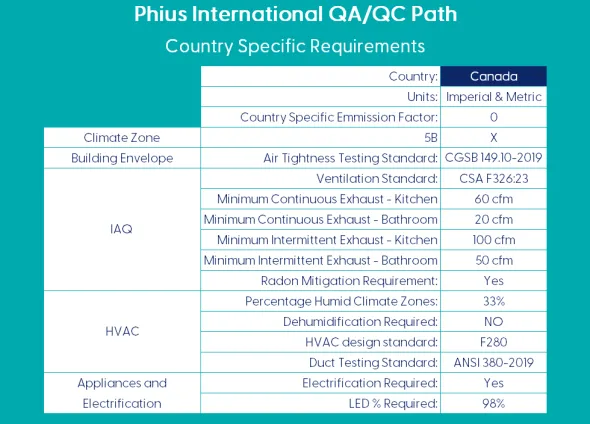
The International QA/QC Path is Phius’ new quality assurance and field verification program for projects outside the U.S. Its verification requirements align with the industry standards each country already uses to design, build, test and verify buildings. It’s available for single-family, multifamily and commercial buildings.
The program includes dedicated training courses for Phius Raters and Verifiers in each participating country, starting with a training in Canada in April 2027 and Japan in May 2027. The trainings will directly align with each country’s verification requirements in the International QA/QC Path.
Why did Phius create the program?
Demand for high-performance buildings is growing worldwide, but Phius quality assurance was built around U.S. programs, testing standards and industry practice. Building Efficiency Resources Ltd (BER) reviewed the Phius verification items and created a refined, customized list designed to align with comparable programs elsewhere.
The International QA/QC Path is designed to ease the burden of the verification process for project teams abroad previously facing unfamiliar standards and units, and testing equipment and training that weren’t always available locally. The program keeps what makes a Phius project a Phius project, while speaking the language of each market it enters.
What are the benefits?
A simplified verification checklist. Streamlined checklists cover building envelope, indoor air quality, heating and cooling, domestic hot water, appliances and electrification and renewables. It focuses on what matters most to building performance and cuts repeat requirements.
Familiar standards and units. Requirements reference each country’s own testing and design standards, in metric, imperial or both.
Dedicated resources for international projects. Country-specific guidance explains local standards and best practices, and shows how to meet Phius requirements with locally available products.
A path that fits local capacity. Requirements reflect the equipment and training available in each market, and will be reviewed approximately every three years as the market matures.
Every building type. Single-family, multifamily and commercial projects all have a route to certification.
The result is a Phius label that means the same thing everywhere, earned through a process local builders, designers and verifiers can work with.
Thank you
The International QA/QC Program would not be possible without the work of Building Efficiency Resources Ltd, whose research and program review shaped it. We’d also like to thank the project teams and Phius-trained professionals around the world whose feedback showed us where our program needed to grow.
What’s next?
Canada and Japan are just the start. The program will expand to more countries, each with requirements and resources built around its own codes and standards. We’ll review requirements in each market about every three years as projects, training and resources grow.
Watch for upcoming blogs on what the launch means for each country, starting with Canada.
Ready to get started? Talk to a Phius Certified Consultant about bringing your next single-family, multifamily or commercial project through Phius Certification. If you work outside the U.S., Canada and Japan, connect with Phius to learn how to bring the program to your market.
About the Author
Natasha Brooks
Director of Operations at Building Efficiency Resources Ltd (BER)