This week’s blog originated as a white paper written by Hiromi Tabei and Emily Durso of Bright Power summarizing the Phius 2024 standard update.
Every three years Phius updates their standards to keep in line with the latest industry trends, climate goals, code cycles, changing climate, etc. Here’s a look at the key changes from the 2021 standard to the 2024 standard, for both Phius new construction projects and Phius REVIVE (existing building) projects.
Phius CORE 2024: New Construction Projects
For Phius 2024 new construction projects, there are no major impacts to certification requirements, however, targets have been re-optimized specifically for dense multifamily buildings. Below is a summary of key updates from Phius 2021 to Phius 2024, specifically for multifamily projects pursuing Phius CORE Certification, including how these changes impact certification and updates to co-requisite program requirements.
Performance Targets
Phius calculates unique, building-specific performance targets for each project based on the following items:
Climate Location
Envelope Area
Interior Conditioned Floor Area (iCFA)
Dwelling Unit Count
Total Number of Bedroom
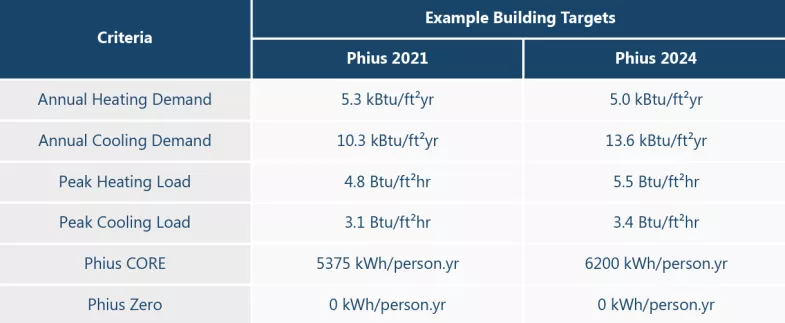
*Summary of the performance path calculator for a residential new construction building in New York City with an envelope area of 100,000 sqft, iCFA of 120,000 sqft, 200 dwelling units and 150 total bedrooms.
The most noticeable change between 2021 and 2024 standards is the increased allowance for annual cooling demand in the performance path calculator. This update better reflects real-world conditions for multifamily buildings, which naturally have higher internal heat gains due to greater occupant density. It’s important to note that while source energy also had a minor increase, source energy factor for the 2024 standard also increased from 1.8 to 2.0 to account for average national emission factors for electricity.
Co-Requisite Programs
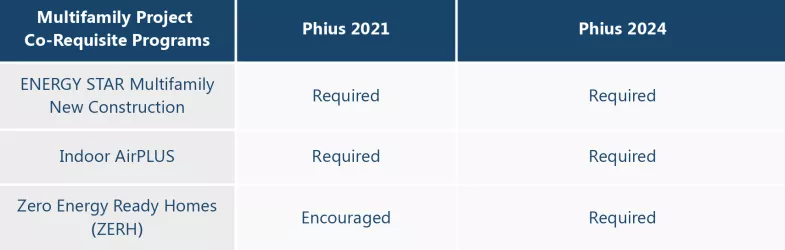
ENERGY STAR Multifamily New Construction and EPA Indoor airPLUS remain required corequisite programs under Phius 2024. The main update for multifamily projects is the formal inclusion of DOE Zero Energy Ready Home (ZERH) certification. While ZERH was previously encouraged under Phius 2021, it is now required for multifamily projects under the 2024 standard. This change reflects the fact that a multifamily-specific ZERH pathway was not yet available when the Phius 2021 standard was released, and now that it exists, Phius has integrated it as a formal requirement.
Minimum Outcome Requirements
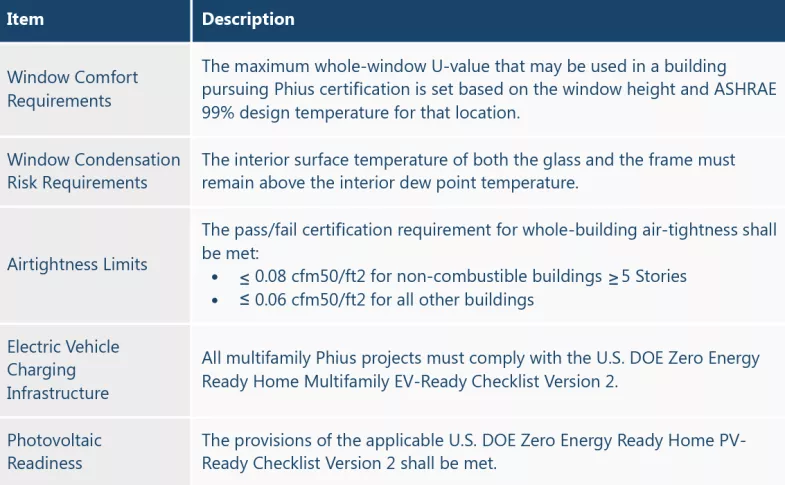
The following minimum outcome requirements remain consistent among Phius 2024 and Phius 2021 standards. The outline below details the requirements that new construction projects must meet for Phius Certification, independent of the building’s modeled performance in WUFI Passive or METr.
Phius REVIVE 2024: Existing Buildings
The Phius REVIVE 2024 Standard was released in July 2024. It represents a complete departure from Phius REVIVE 2021 and introduces its own set of requirements that are entirely independent of the new construction program standards. With core objectives focused on resilience, health and decarbonization, REVIVE 2024 balances project costs through the Annualized Decarbonization of Retrofitted Buildings (ADORB) metric, requiring that the sum of the annualized costs in the proposed design must not exceed those of the existing baseline conditions. One key process difference from the 2021 standard is the introduction of the Assessment & Investigation Phase — a new step that takes place after determining a building is a strong retrofit candidate, but before the design phase begins.
Key purposes of REVIVE 2024 are to:
Eliminate direct and indirect greenhouse gas emissions in normal operation
Provide resilience in the face of power outages in extreme weather conditions
Fix defects of concern that pose risks to indoor air quality according to the U.S. Environmental Protection Agency (EPA)
Fortify the building against certain site hazards of concern according to U.S. Federal Emergency Management Agency (FEMA) and insurers, where appropriate
Meet elective requirements described in the standard document as selected by the Owner
Employ a commissioning and quality assurance process
Calculate the climate impact of the retrofit work and make efforts to reduce it
Collect data on project costs, post-retrofit performance, and lessons learned
REVIVE 2024 Core Objectives & Outcome Goals
Resilience
A project should be resilient to grid disruptions and extended power outages. REVIVE 2024 simulates seven-day outages during extreme winter and summer weather conditions to ensure the entire building remains habitable throughout the week-long event.
Health
Every building should promote the health of both its occupants and the planet. A project should safeguard users from site-specific hazards and eliminate unhealthy elements throughout construction and after the building is occupied.
Decarbonization
In a perfect world, buildings and their supply chains would generate no emissions throughout their entire life cycle. While that goal isn't yet achievable, REVIVE 2024 takes a significant step forward by aiming to minimize the cost of carbon across all phases of a project. This includes embodied (up-front) carbon, operational carbon, and the cost of transitioning to low-carbon energy systems, such as renewable energy and storage.
While balancing project costs through the ADORB metric, REVIVE 2024 requires that the sum of the annualized costs in the proposed design must not exceed those of the existing baseline conditions.
Co-Requisite Requirements for Multifamily Projects
*Applies ONLY to new additions. Eligibility limitations do not apply. The verification, partnership, training, and credentialing requirements do not apply because they are superseded by the commissioning requirements of the Phius REVIVE 2024 Standard v24.0.
Certification Process
Building Certification Requirements for Multifamily
Deliverables for the building certification are the following:
REVIVE 2024 Assessment & Investigation Workbook
This Excel-based document includes the existing conditions assessment of the Minimum Outcome Requirements items, issues and resolution log, Current Facility Requirements (CFR), etc.
Design documents addressing CFR and Owner’s Project Requirements (OPR)
Commissioning (Cx) Plan / Report
REVIVEcalc v24.2.0, not WUFI Passive
Submittal Review Report
Implementation Plan / Report
Systems Manual Materials
Interested in Phius 2024?
Bright Power is ready and able to support your project in its pursuit of Phius 2024 Certification, whether for new construction or existing buildings. If you’re unsure whether the program is a good fit for your project, reach out to us to conduct a feasibility study assessment to better understand where your project fits relative to program targets and requirements.