Phius Senior Scientist Graham Wright and Building Certification Associates Abigail Sefah and Alyssa Fink reflect on their experiences at the 2026 Westford Symposium on Building Science.
I’m pleased to report that Building Science Corporation recently pulled off their annual Westford Symposium on Building Science (also known as Building Science Summer Camp) for the 28th year in a row¹, and it met the same high standards I’ve observed in attending it most years since 2015.
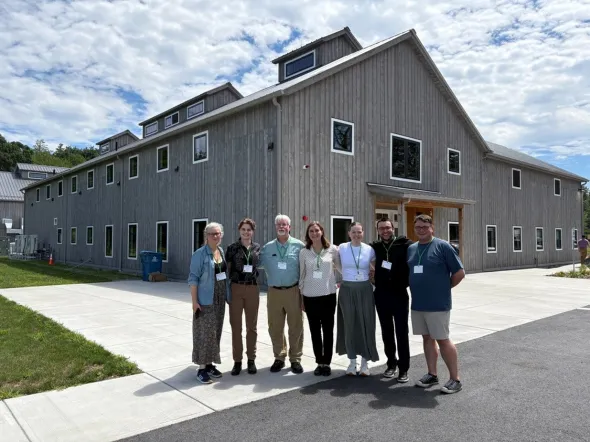
Building Science Summer Camp attendees (left to right) Katrin Klingenberg, Alyssa Fink, Graham Wright, Abigail Sefah, Margaret Goetsch, James Ortega and Al Mitchell pose for a photo outside the event venue
The event is basically a one-track, three-day, by-invitation conference with a nightly backyard barbecue including live music, drinking and dancing. There’s nothing else like it. But as with other technical conferences, I kept an eye out for whether we at Phius are on the right track and for insights that can help us improve our programs.
My main takeaway from the event was the focus on attending more to indoor air quality. A few examples include:
Ashley Murphree, Founder & Principal Engineer of Alchemech Engineering, reported on problems she encountered living in a tiny house, pointing out that contaminant sources are more concentrated in small spaces, and opining that occupants are becoming more sensitized because of stresses related to climate change such as bad outdoor air and airborne viruses. She concluded that tight homes are safe with managed indoor ecology, and added that heating/cooling coils should be kept clean with filters ahead of the coil, and that recirculating air cleaning should be installed as standard, mentioning ASHRAE Standard 241 for control of infectious aerosols. When it came to hoods, laundry, and makeup air, our Phius intermittent exhaust and makeup air calculator got a nod, along with Building America’s Red Calc™ tool for depressurization analysis.
Ty Newell, Engineer/Owner of Build Equinox, presented about his HVAC device, the CERV, saying that ASHRAE 241 should be standard, and explained how formaldehyde attacks the copper coils in HVAC equipment, causing pinholes.
Nick Hurst, presenting about the history and future of ventilation and indoor air quality, said filtration must improve in ventilation standards, including filtering of the outdoor air, and there should be a maximum ventilation limit in hot humid climates to avoid latent loading.
Bill Bahnfleth, chair of the ASHRAE 241 committee, reported that there has been technical progress “towards better indoor environments for all,” with Standard 241, Guideline 44 for wildfire smoke, and the performance path for Standard 62.2 for residential ventilation, but that policy and regulatory adoption has been mostly symbolic, lacking operational requirements. Phius could lead in this area I think.
There were also a couple of mechanical system items that stood out to me.
Architect Chris Benedict knocked herself out doing an all-electric multifamily high-rise in New York City, which was also modular (Phius project 2145 Linden Grove). They ended up with a lot of refrigerant piping for heating/cooling distribution and a lot of electrical conduit. She said she might do hydronic distribution in the future, or fall back to gas for water heat. Ty Newell and I thought appliance batteries might save a lot of electrical wiring.
Phius Tech Committee member Galen Staengl spoke in favor of hydronic distribution for heating and cooling, monoblock heat pumps (where all the refrigerant is in the outdoor unit), and neutral-loop distribution that includes individual heat pumps serving each apartment and drawing heating or cooling from a loop running tepid water.
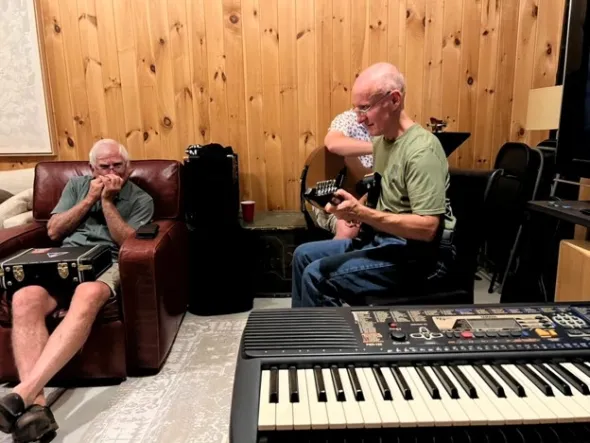
As to the evening festivities, I was touched to be invited by Eric Werling to play a guitar song on the main stage, but backed out when I couldn’t play it in the right key. I did play in the smaller backyard hut venue as I’ve done in years past.
The Phius contingent included several first-timers who led themselves ably through the professional and party portions of the event without taking much damage — one possible dance injury notwithstanding. Below are some of their reflections from the experience.
Newcomer's Perspective Abigail Sefah
My first time attending summer camp was an honor and a unique experience that was different from any industry conference or summer camp I’ve ever attended. It was a truly fascinating combination of the two.
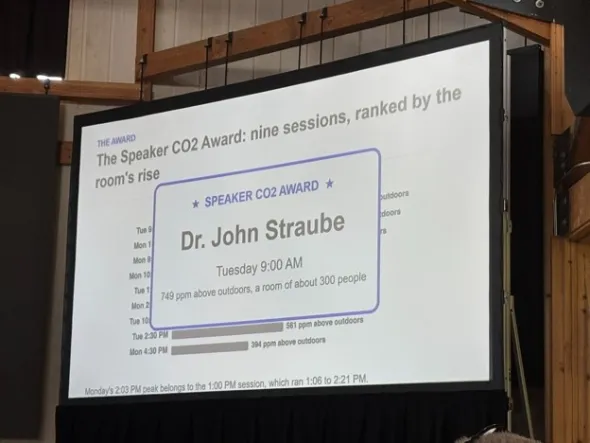
I appreciated the diversity in topics in the daily sessions. A favorite was John Straube’s “Drain, Drain, Go Away,” during which he presented the research his group performed at the University of Waterloo to back up various building science best practices. For years I’ve been recommending small but impactful modifications to common details, such as adding an angled hemmed drip edge to metal flashings, and his work quantifies why those details are important. Apparently many others enjoyed this session as well, as it received the “speaker CO2 award” for the highest CO2 levels as measured by occupancy sensors around the room (more on those in Todd DeMonte’s presentation, “24 Sensors, 2 Buildings, 48 Hours”).
As a first-time attendee, I enjoyed hearing stories of Summer Camps over the decades from old-timers. The history of the event and the community it creates are unparalleled among conferences I have attended. Seeing familiar faces and having time to reconnect over three-course backyard dinners was refreshing. As I met new people with different areas of expertise from around the country, some fascinating conversations emerged. We chatted about everything from whole-building air leakage testing to bug spray (the mosquitos were feasting as well), and I came away with a refreshed passion for designing good buildings for healthy occupants.
Newcomer's Perspective: Alyssa Fink
When I first heard about the Westford Symposium a couple years ago, it sounded like an event of mythic proportions, so I was excited to attend on Phius’ behalf this year.
One aspect of Summer Camp that I found particularly valuable was the opportunity to connect with people from across the spectrum of building science-related professions. Since there was a single session running at any one time, attendees with very different backgrounds remained mixed, and I knew that I would have something interesting to talk about with everyone that I met.
The environment was also tailored to incentivize meaningful connection, with ample time to connect over good food, good drinks and good music. I personally had the chance to chat with researchers from a national laboratory, architects from around the world, construction supervisors, engineers, industry association representatives and many more folks.
This helped put the work we do at Phius into perspective, and highlighted the fact that we all need to collaborate in order to build better buildings. I know the connections I made at Summer Camp will continue to be valuable moving forward.
¹ Except they did skip one year at the beginning of the Covid pandemic
About the Author
Graham S. Wright, PhD
Chief Building Scientist & Chair of the Phius Technical Committee