Here at Phius, it is a strong focus of our technical staff to support our constituency – you, the practitioner – and aid you in designing better buildings.
Part of this effort is the development of calculation protocol and calculators for the various building systems that you are trying to quantify the impacts of and analyze. As Phius has grown, and the number, size and complexity of projects increase, it becomes necessary to update old calculators to work with the type of projects we are seeing. This is a true benefit of the iterative feedback loop between project review and research and development.
The previous version of this calculator was two calculators in one: a section to estimate the number of range hoods operating simultaneously and a section to estimate an allowance for direct exhaust that would require make up air.
In single-family mode, the calculator used the exhaust value entered and determined if this was below the allowance, which was calculated by determining the air flow that would occur if the envelope was depressurized by 5 Pa. This was all well and good, but the issue occurred in multifamily mode. The calculator had hard coded in a 12% diversity factor, which did not necessarily reflect real conditions.
Consider this: in a four-unit building, with in-unit range hoods exhausting 100 cfm, the total possible flow would be 400 cfm. However, the calculator would assume 400 cfm * 0.12 = 48 cfm as the total possible exhaust, so less than one range hood would be operating at one time. This calculator also only calculates the exhaust flow potential from range hoods, and would not account for dryers.
New Version
The new version of this calculator uses a more detailed method to determine the diversity factor and can model four types of direct-exhaust devices: in-unit dryers and range hoods, and common area range hoods and dryers.
The underlying calculator to determine this diversity factor is a Monte Carlo simulation. For those familiar with the Las Vegas casino, but not sure what this has to do with building science, let me briefly explain. The Monte Carlo method was developed by mathematician Stanisław Ulam at the Monte Carlo Casino in Monaco, and it utilizes a random input sample and a probability of events occurring to determine an output. The more input samples used, the better the convergence of the output. This method is used in problems in which the end result is not necessarily deterministic, but probabilistic, such as nuclear physics, traffic patterns, or in our case, occupant behavior.
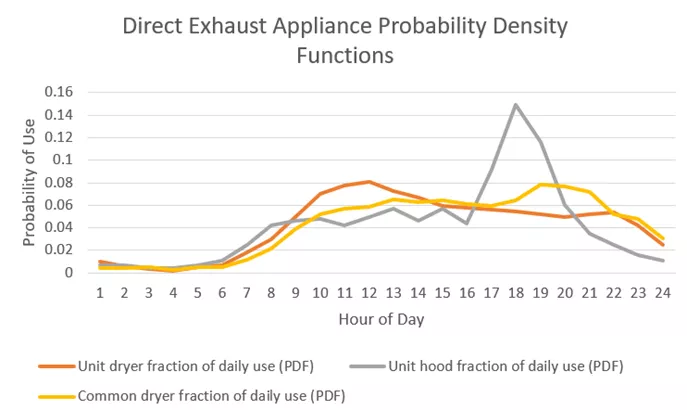
This figure details the hourly probability density function for each of the exhaust device types used in the Monte Carlo simulation.
Utilizing the Building America House Simulation Protocol schedules as a probability density function (PDF), a random input was used to determine the hours out of the year that a device would be operating. For example, WUFI Passive assumes 57 uses per occupant per year of a dryer. If we have 2 occupants per dryer, each dryer would get used 114 times per year. The random input selects 114 hours of the year, based on the PDF, that the dryer would be operating, and adds them to a list. If we have our four-unit building from above, each dryer will have its own unique operating schedule based on this analysis.
Having run a Monte Carlo simulation on various occupants per dryer and number of units in the building, the estimator contains a series of tabs with 8,760 hours of data on the number of different direct exhaust devices running. The estimator then multiplies the number of devices running by their respective exhaust flow rate, and sums the total flow for each hour, resulting in 8,760 hours of potential air flows. Then, the 99.6% percentile flow is selected as the peak coincident flow used to determine if make up air is needed.
Currently, the estimator supports buildings up to 149 units, and will determine the peak coincident flow for the common dryers, in-unit dryers, and in-unit range hoods. Any common range hoods have their flow added directly to the peak coincident exhaust flow rate, as there is not good data on their usage.
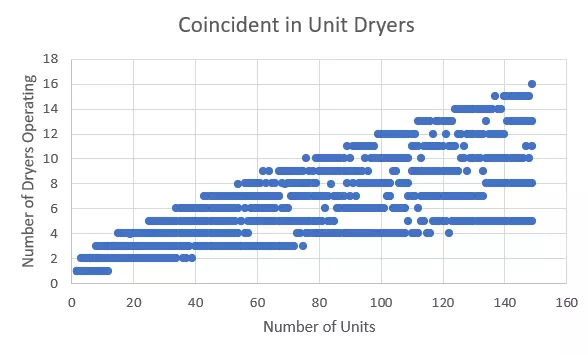
This figure details the number of coincident in-unit dryers for various multifamily densities. Depending on the occupant density per unit, more coincident use is possible, shown by the horizontal striations on the graph.
Once the potential coincident exhaust flow is calculated, this can be compared to the total exhaust allowance determined by the second section of the estimator, where the same limit of 5 Pa applies.