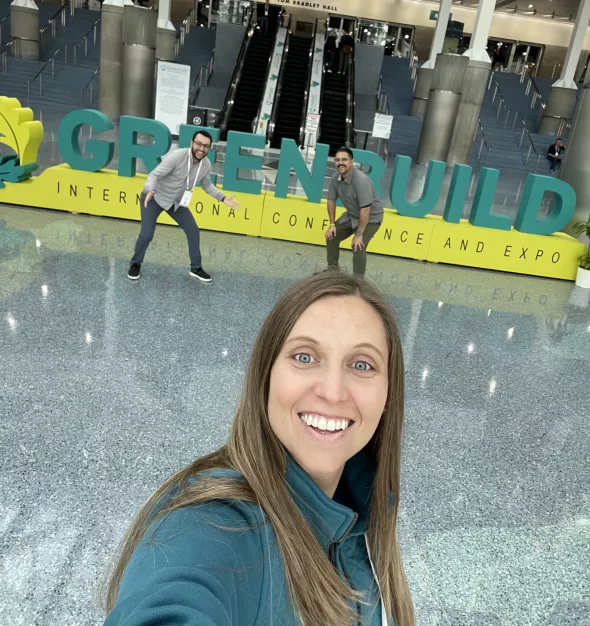
This past week, three of my Phius colleagues and I made the trek out to Los Angeles for Greenbuild 2025. It’s not often that Phius makes its way out to California, so it was a treat to enjoy 75°F and full sun in November with the rest of our delegation.
I’m originally from SoCal, and I can’t help but see the issues our buildings face in a different light after spending some time working for Phius. While outdoor Thanksgiving and Christmas gatherings are commonplace where I grew up, so are blazing hot summers with plenty of time spent indoors. I remember the air conditioner running more often than not, blinds and shutters kept closed, and rolling blackouts during the hottest weeks as the grid struggled to keep up with the cooling demand.
As it turns out, aluminum foil and car shades don’t perform quite as well as double-pane, LoE windows, but that didn’t stop most homes on my block from trying. Windows may have come a long way since the 1990s, but passive building principles still seem to carry some cold climate bias out west.
So, why Los Angeles? And why Greenbuild?
Southern California extends far beyond Los Angeles and Orange County. Beyond Dodger Stadium and Disneyland, the suburban sprawl continues eastward as the farmland and open desert of San Bernardino and Riverside counties now host tract homes and quickly growing communities. Residents of the Inland Empire experience hot, dry summers and near-freezing temperatures during winter nights — not exactly the “perfect California weather” stereotype. Factor in that 22% of all cars sold in California last year were electric vehicles, and you get an electric grid that needs all the help it can get.
This specific example is one of many that illustrate the use case for passive building in all climates. The west coast and warmer climates are not immune from the typical issues around energy use, especially when it comes to the mismatch of the timing of renewables and the demand for energy (also known as the “duck curve”).
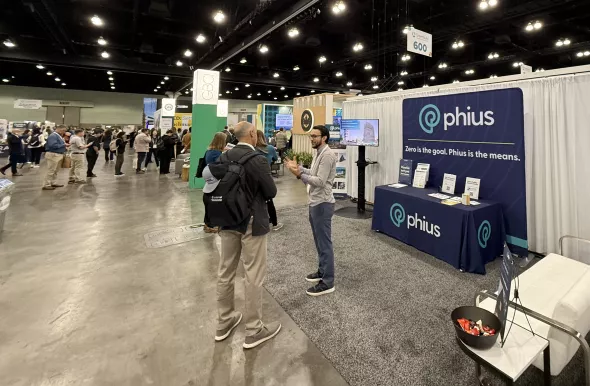
Highlights from the Phius Greenbuild Booth
Based on the conversations we had this year, Phius and passive building are quickly becoming more familiar to LEED practitioners. Broad questions such as “What does Phius do?” were mostly replaced by specific inquiries about training and certification. Many of the attendees who passed by the Phius booth in the expo hall were pleased to learn that Phius is not in competition with LEED nor are the two standards mutually exclusive. In fact, the two are often complementary. LEED covers important sustainability themes that are out of scope for the Phius standards — categories such as site, materials, and resources — while Phius zeroes in on whole-building energy usage.
Our booth drew steady traffic, which was encouraging for us at an event with a broader focus, such as Greenbuild. Attendees who stopped by were eager to clarify their understanding of Phius, our standards, and training programs. We were glad to speak not only to sustainability veterans, but also some who were just making their way into the field. We were more than happy to dispel some of the lingering “passive house myths” that still pop up on occasion (to be clear, you can open the windows in a passive building).
Looking ahead: New York in 2026
We’re excited to return to Greenbuild next year in New York. California is an important stop for outreach and represents a key area for expansion, and we don’t intend to be strangers to the west coast. That said, New York and the northeast region are critical for Phius and passive building. Code and incentives in New York and New England are pushing passive building to the forefront, and demand for Phius training and certification continues to grow exponentially. We look forward to seeing everyone in Manhattan next October!