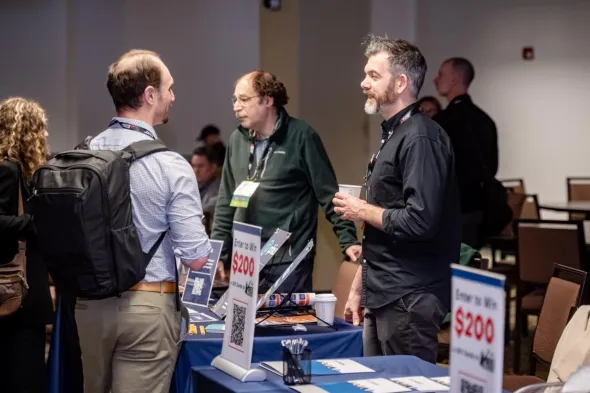
As always, Phius was thrilled to attend the Northeast Sustainable Energy Association’s (NESEA) BuildingEnergy Boston 2026 conference, which took place March 23-24. We always send a strong Phius contingent to the event, and this year was no different. Our attendees included Katrin Klingenberg, Isaac Elnecave, Abigail Sefah, Margaret Goetsch and John Loercher.
Phius staff members Isaac Elnecave (middle) and John Loercher (right) greet passersby in the BuildingEnergy Boston 2026 exhibit hall. Photo courtesy of NESEA
The conference came on the heels of recent Phius updates to the Efficient New Homes corequisite requirement, which was a hot topic among visitors to the Phius booth. It was wonderful to see many familiar faces, and cross paths with policymakers, architects, engineers, manufacturers, and students representing a wide spectrum of familiarity with Phius. The two-day conference provided great conversations throughout, and new perspectives within the sessions.
Below you’ll find reflections from two first-time BuildingEnergy Boston attendees and Phius Building Certification Associates Maggie Goetsch and Abigail Sefah .
Educating and Learning: Maggie Goetsch’s Reflections
I am grateful to have had the opportunity to attend NESEA as a speaker and to represent Phius. Being that this was my first conference outside of PhiusCon, the sessions and conversations offered valuable insight into differing perspectives within the field. The session I had the chance to take part in, “Are you smarter than a Phius reviewer?”, was a light-hearted introduction to the details of many Phius projects that often get flagged in reviews. This session was put together by Molly Craft (New Ecology), with myself, Betsy Cooke (PCA Design), and Nicole Schuster (Positive Trace) as the panelists. The audience members offered wonderful participation in helping the volunteers answer the questions, and asking their own follow-up questions. This was a great first iteration, with many attendees expressing that they hope to join again in the future with even more details/questions incorporated into the session.
While at NESEA, I also attended a variety of case studies. From retrofit projects to schools, and all the elements that go into making them successful from an energy standpoint, I came away with a better understanding of how projects can achieve similar outcomes with a wide range of priorities. Aside from sessions with multiple case studies, I also attended a session which provided insight into how sustainability can be presented without explicitly saying “sustainability.” This presents a greater conversation regarding how to present various elements or principles (including Phius) in a way that is compelling to a project’s specific needs and priorities.
Immersing in the Industry: Abigail Sefah’s Reflections
This was my first time at NESEA’s BuildingEnergy Boston and my first conference as a Phius representative. It was exciting to be on the “other side” of the booth, sharing information about our organization and mission with everyone, from seasoned CPHCs to those who were curious how to pronounce “Phius.”
As an employee located in the Boston area, I saw many familiar faces from past conferences, seminars and projects, and got to put names to faces for several people. I’m learning that the passive building design community is small — but growing! I’m relatively new at Phius, so I also enjoyed meeting some of my Phius colleagues in person, and spending time getting to know them better.
At the sessions themselves, I learned about the business case for sustainable design. It turns out that when employees are working next to a cold, possibly condensation-covered, window surface, they’re less productive — intuitive, but this has been proven experimentally (not just anecdotally by Phius). I got to hear diverse perspectives from leaders in their fields, which helped give me a more holistic understanding of the wide range of perspectives that exist in the industry. Learning from experts, both from the stage and from one-on-one conversations, is why conferences like NESEA are so special and critical.
Where do we go from here?
Getting to know different people and perspectives and share the critical work we’re doing are at the heart of our attendance at NESEA. We were reminded how being a small, versatile organization allows us to make connections with people and follow up with real improvements and adaptations.
Even if you weren’t at BuildingEnergy Boston, we are available and eager for your input and feedback — reach out to us via the Phius contact us form here. High-quality passive building design at the forefront of technology and design is ever evolving and expanding, and it takes all of us to continually design and build even better buildings.