PH Mass Symposium Wraps Up Busy Year for Phius Policy Team
Phius Senior Policy Analyst Isaac Elnecave provides a recap from the recent PH Mass Symposium and Phius Policy Specialist Zoe Rader offers a recap of other appearances and achievements of the Phius policy team in 2025.
The last 12 months have been plenty busy for the policy team at Phius! From several conferences, happy hours, and other events, to getting Phius written into various policy types such as incentives, codes, and QAPs, to beginning to track active Phius projects tied to active Phius policies, we had a productive year.
Most recently, we attended the annual PH Massachusetts Symposium. Below is our report from the event, written by Phius Senior Policy Analyst Isaac Elnecave, followed by a year-end wrap-up of the Phius Policy team’s activities and accomplishments.
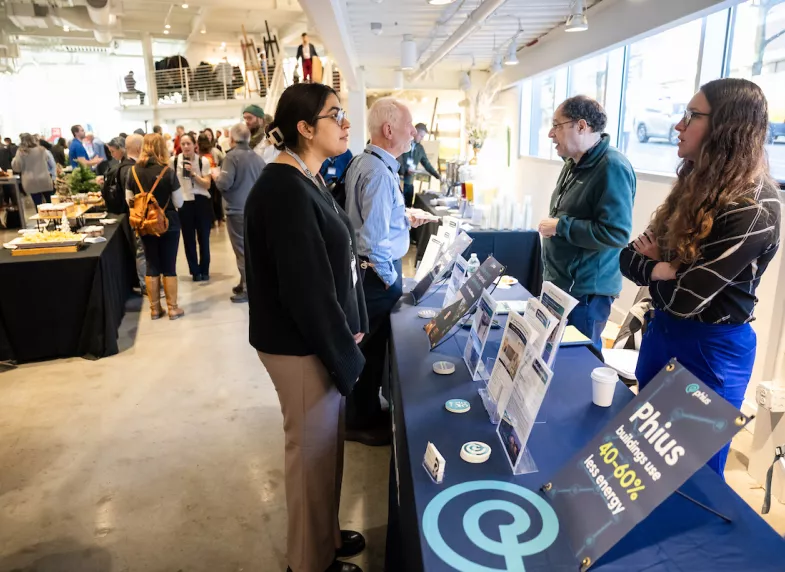
PH Mass held its annual symposium on Dec. 9, which had the theme of "Raising Standards, Lowering Costs." It is the second symposium to be held after the promulgation of the Opt-In Specialized Code (which requires meeting Phius or another “passive house” standard for residential buildings over 12,000 square feet). Consequently, interest in passive building construction is growing rapidly (in Massachusetts alone, there are 300 projects in the pipeline). This was evidenced by the fact that 300 people attended the Symposium (and it could have been more as the location had an occupancy limit of 300). Attendees ranged from people who had been working on Phius projects for years to those hearing about it for the first time.
Presentation topics included: avoiding cost overruns, minimizing both risks and costs, navigating the various options with respect to complying with the Opt-in Specialized code, and achieving certification in the shortest amount of time, among others. These presentations showed that Phius is moving from a niche standard used by few people to a more broad based standard that, with any luck, will soon become among the dominant modes of construction in the state. And as always, the side conversations in between panel discussions were incredibly useful.
Presentations were made by architects, construction companies and energy rating companies of varying sizes. It is important that many of the firms have already completed multiple projects, and so brought deep experience and knowledge to their presentations. We expect that with the continuing upward trajectory in Phius projects that next year's Symposium will be even bigger.
Professional Development Panel with Ball State University
I sat in on a panel discussion with other professionals within the building industry to speak with students and young professionals about non-traditional pathways after architecture school that still relates to the building industry, such as a policymaker with an architecture background.
Better Buildings: Better Business (B4 Conference)
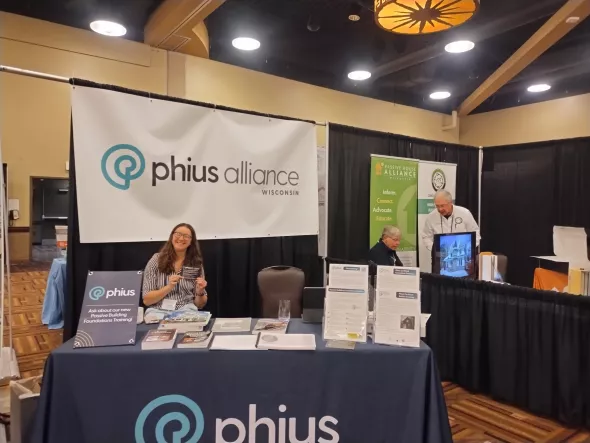
I attended the B4 Conference in Milwaukee, Wisconsin this year and was able to meet with members of the Wisconsin Phius Alliance to discuss how to continue policy momentum after getting written into Wisconsin’s QAP this year. We discussed strategies on how to turn policies into projects (which is our team’s ultimate goal) and they were able to help me connect with Wisconsin policymakers.
Northeast Sustainable Energy Association (NESEA) 50th Anniversary Celebration
Isaac and I attended NESEA’s 50th Anniversary Celebration where we got to see old faces and new alike. With many cities in Massachusetts adopting the opt-in specialized code, we were both able to have various conversations with people from all corners of the Phius community: Alliance members, Phius Raters/Verifiers, Phius Certified Consultants, etc. Common topics of conversation ranged from the certification process to Mass Save funding incentives.
Policy Happy Hour with Passive House Northwest (PHNW)
I was lucky enough to attend a happy hour with members of PHNW during which we discussed existing, new, and potential policies in Seattle, Washington, and the northwest region in general. See “Policy Successes” below for more information.
Environment and Energy Study Institute (EESI) Congressional Renewable Energy and Energy Efficiency Policy Forum, EXPO and Reception
Katrin Klingenberg and I attended EESI’s Congressional Policy Forum where Katrin delivered a presentation on Phius to introduce members of congress and other various policymakers to Phius’ work. Throughout the day, I was able to staff a table in the exhibit hall where I had one-on-one conversations with those same members of congress and policymakers to dive deeper into the importance of Phius and what we can do for the built environment.
Wisconsin Housing and Economic Development Authority (WHEDA) Conference
Isaac attended the WHEDA Conference and had many conversations with real estate professionals wanting to learn more about Phius. He also learned that the city of Fitchburg (a suburb of Madison) is going to have a meeting to discuss Phius and its possible place in the city's sustainability plan. And finally, he had a discussion with Emily Harris, the Chief Policy Advisor at WHEDA, where he learned that though Phius has been included in Wisconsin’s QAP, it hasn’t led to projects pursuing certification. This has led to further discussion about next steps for 2026. See “What’s Next?” below for more information.
Ohio Housing Finance Agency (OHFA) Conference
I attended OHFA’s conference where they had a session dedicated to further development of Ohio’s QAP where I was able to have group discussions with architects, developers, and builders to gain a better understanding of what they find prohibitive about Phius. I was also able to have a one-on-one discussion with an OHFA representative during which we discussed the potential of Phius becoming a bigger part of the QAP.
Phius was included as an Alternative Compliance Path in the Maine Stretch Code
Phius was included as an Alternative Compliance Path in the Oregon Stretch Code
Policy to Projects
The ultimate goal of the policy team at Phius is to turn policies into projects. There isn’t much impact in getting a Phius policy written if it doesn’t mean that professionals aren’t taking advantage of those policies. Therefore, as a team, we have begun a closer tracking of which Phius projects are utilizing funding from Phius policies.
As of December of this year, we have nearly 120 projects tied to Phius policies. As we continue researching new and existing projects alike, we can only expect for that number to grow.
What’s Next?
Though we anticipate continuing our efforts into implementing more Phius policies, we also want to strategize on how to generate more projects from existing policies; we aim to build upon the foundation we have already set.
Continued efforts:
Working with the city of Arlington Virginia to establish a pilot program incentivizing Phius
Working with the city of Seattle on establishing Phius as the energy code in the city
Working with the Ohio Home Financing Agency to include Phius in its upcoming Qualified Allocation Plan update
2026 Initiatives:
Outreach to the state of Maryland as it looks to update its energy code
Work with stakeholders in Colorado, and other states with existing Phius policies, to generate more projects.
We are grateful for the passionate Phius community members who make these policy successes possible, and we look forward to many more in 2026!