Everyone in the passive building industry has their aha! moment. The moment it all comes together with the seemingly disparate principles coalescing into the tangible idea of how a building should be built, and how it should feel.
My aha! moment occurred while standing inside a passive building. Like many things in life, the indoor environment of a passive building can be difficult to articulate, but unmistakable when experienced firsthand.
For me, it was the simple opening and closing of a window about 15 floors up in a high-rise Phius building in the Bronx, New York, that made everything click. As a Chicago resident, I’m no stranger to background city noise, so I didn’t pay much mind to the bus engines and car horns thrumming below during our tour that day. But when one of our hosts approached an open window, pushed it closed and turned the handle to secure it, I was amazed at what happened. The noise from the street disappeared completely.
If I closed my eyes, I wouldn’t have been able to tell if I was in the middle of the Bronx or Manhattan or Manhattan, Kansas. It was a little surreal to be in such a carefully controlled indoor environment. From there, I really started to notice the other aspects of Phius buildings we talk about so frequently: the even temperatures, lack of drafts and indoor air quality to name a few. It all clicked for me then. This is what my more experienced colleagues mean when they say things like “I don’t know why you would build any other way.” Because this is how buildings should feel.
Having now had the privilege of touring about 10 different Phius buildings, the best and simplest way I have found to describe the living environment — though it doesn’t quite do it justice — is stillness. The air is calm, there aren’t sharp temperature fluctuations or drafts tickling your neck, and the outside world is seen, but not heard. It takes a little time to truly appreciate it, but it is a one-of-one experience.
Visiting a passive building leaves a strong impression, but it seems like every time I find myself in one, the indoor environment surprises me. That’s a feeling I had just today as a couple of my Phius colleagues and I had the opportunity to tour the wonderful, award-winning Pierce at 7 Van Buren Phius ZERO Certified building in Oak Park, Illinois, along with the project's Phius Certified Consultant (CPHC®) Tom Bassett-Dilley.
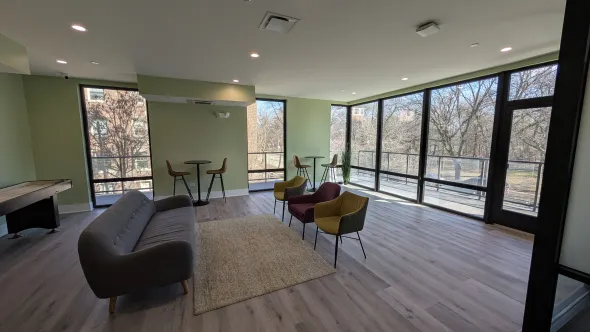
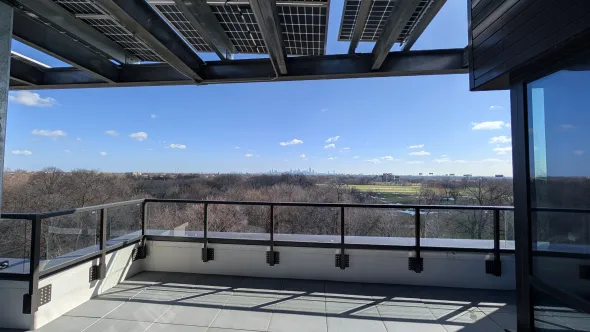
There are countless aspects of the 7 Van Buren building that make it unique, but after spending a few minutes inside, it felt oh so familiar. The building offered a warm reprieve from the blustery weather outside, and as our host David Pope opened and closed a balcony door in the resident lounge, we watched and listened as the sights and sounds of the Austin Boulevard thoroughfare below was reduced to only sights.
The 7 Van Buren project is a fantastic example of what a Phius building can offer both a community as a whole as well as the building’s tenants. It is an efficient, healthy, resilient place to live, and one of the goals of its design was to make it a replicable template for similar communities throughout the Midwest and beyond.
I suspect it will be a valuable example for other project teams to take inspiration from and point to as proof of concept should they run into naysaying policymakers or code officials, but it served a different purpose for me. It offered a still, quiet, yet undeniable reminder of why our community works so hard to make passive building the market standard. Everyone deserves to live in a building that provides constant peace of mind like 7 Van Buren.
And while we will have much more on the 7 Van Buren project and how it came to be in later blogs (stay tuned!), for now I will leave you with some advice you probably don’t need. No matter if you’ve been in one Phius building or a hundred, or if you’ve had your own aha! moment or not — never pass up an opportunity to experience a passive building first hand.