Our monthly Project Spotlights highlight the cutting-edge work being done by Phius professionals and provide examples of successful design and construction strategies. We feature projects of various sizes, typologies, and climate zones, offering you a peek behind the curtain of each.
Our September Project Spotlight is: Yannell Passive House in Chicago! The single-family retrofit project was recognized in the 2023 Phius Passive Projects Design Competition.
Project Team
CPHC: Scott Farbman
Architecture Planning: HPZS
Construction Company: MK Construction, Inc.
QA/QC: Ibrane Juarez
Developer: Michael Yannell with The Yannell Foundation for Sustainable Development
Additional Consultants: Goodfriend Magruder Structure LLC, Todd Szwajkowski with SwakeGroup with Dream Town Realty
An Inside Look
The Yannell Phius+ House was the first certified single-family Phius+ 2018 renovation in the 14-state Midwest region, making it the first successful decarbonization project of its kind in both Illinois and in Chicago. Starting as a speculative development concept in 2017 and completed in the summer of 2020, it sold on its first showing in September 2020. It has received significant press coverage, with videos of the project and a dedicated website produced to reach the greatest number of future homeowners and builders with the message that development of this type is necessary and possible.
The design team was presented with existing building and urban site constraints prohibiting optimal passive design performance and strategies, challenges which existing buildings often face. High costs for excavation sidelined the team’s goals for sub-grade exterior insulation, which led to alternative design approaches that balanced both thermal bridging and thermal performance without compromising material durability. Chicago-specific mechanical codes prevented optimal exhaust and ventilation designs, leading to higher volumes of air being moved and larger pieces of equipment required. A remarkable aspect of the project was working with a builder who had completed separate components of sustainable projects, like utilizing an ERV or photovoltaics, but was not Phius credentialed. Constructing the renovation successfully with the guidance of the project team, this is one of the more powerful aspects of the project’s success – that development driven builders can successfully execute Phius-level work.
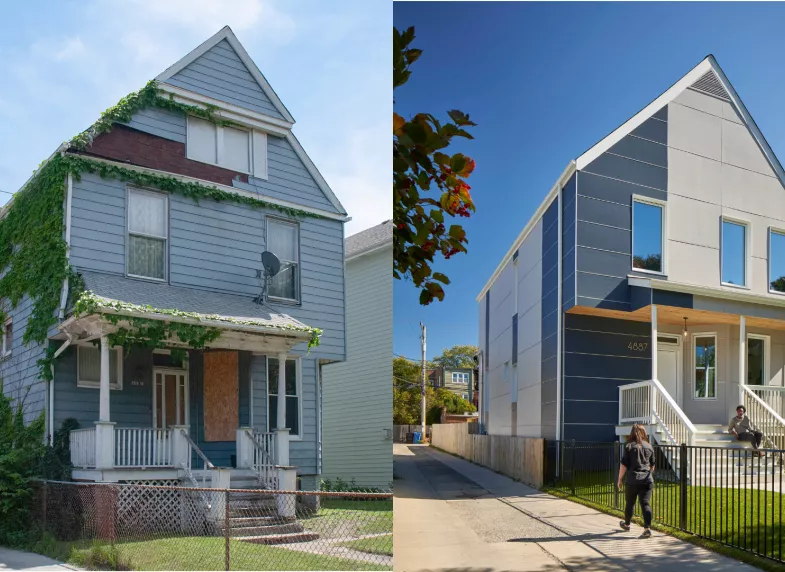
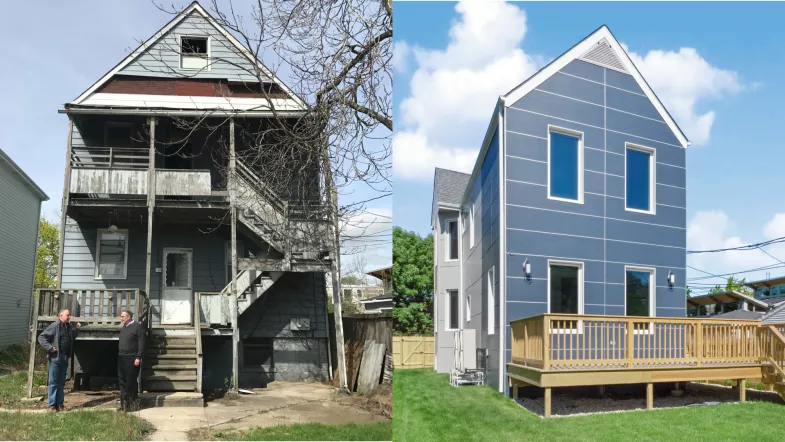
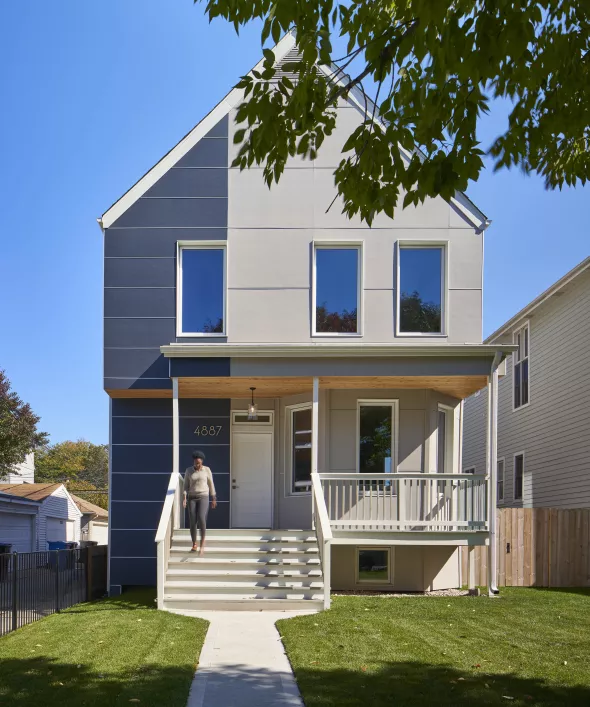
The project was conceived to demonstrate to the growing speculative home renovation building market that renovations can achieve the greatest level of energy efficiency and sustainability by meeting Phius benchmarks, thus meeting 2050 decarbonization goals, providing a model for existing building electrification and development profit. Following strict Phius guidelines, one of the neighborhood’s original homes from the 1890s was completely reinterpreted and re-engineered into the home of the future along a commuter rail corridor, where thousands of people were able to watch the structure’s transformation. The reimagining of the envelope adds interest to a deteriorating form previously shrouded in vegetation while noting modern simplicity and movement through color seen in adjacent vintage homes. It pays homage to the past, while the utilization of more modern cladding such as fiber cement indicates that this typical form has been modernized.