Our monthly Project Spotlights highlight the cutting-edge work being done by Phius professionals and provide examples of successful design and construction strategies. We feature projects of various sizes, typologies, and climate zones, offering you a peek behind the curtain of each.
Builder: Scott and Larry Berliant | Berliant Builders, Inc.
CPHC: Scott Farbman CPHC | db|HMS
QA/QC: Eco Achievers
Owner/Developer: Margaret Stender
An Inside Look
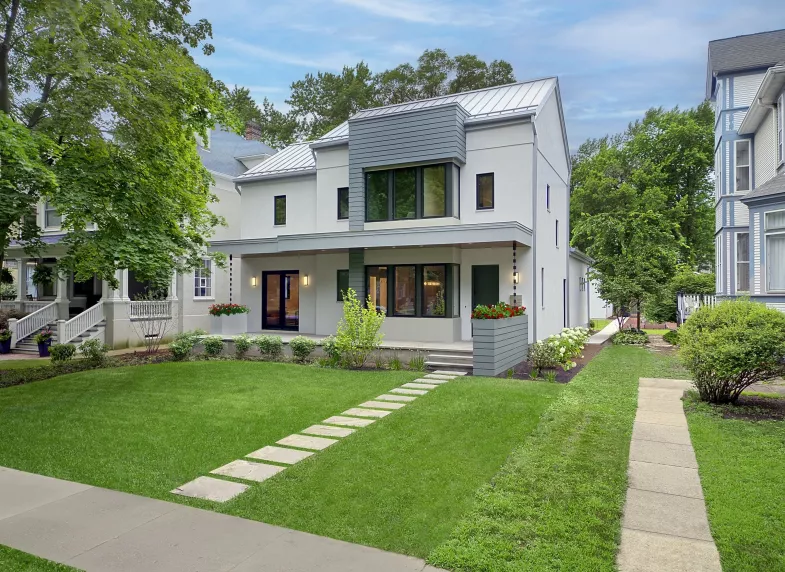
Evanston’s First Passive House is a Phius Zero Certified home that combines rigorous performance with refined modern design, realized within the constraints of a designated historic district.
Minimal maintenance and a very small carbon footprint, both operational and embodied, were also central to the brief. CO2 injected concrete combined with the elimination of a basement helped reduce the concrete’s impact.
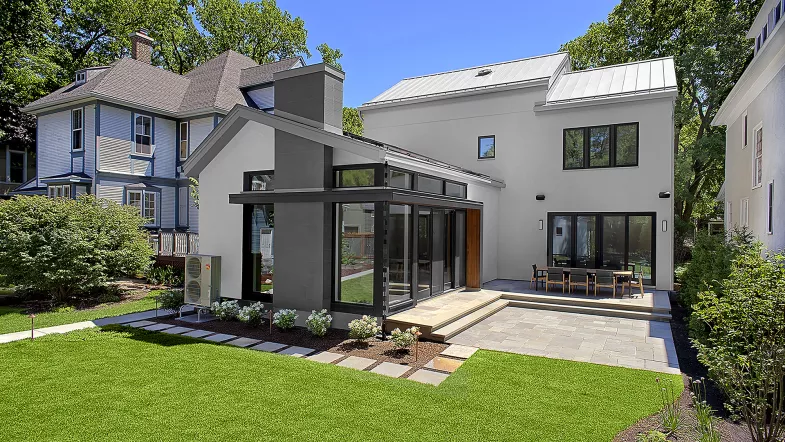
To respect preservation guidelines while advancing Phius standards, the home has slender, front-to-back massing with an L-shaped, single-story family room. This minimized the footprint, reduced visual impact, and created a strong sense of place.
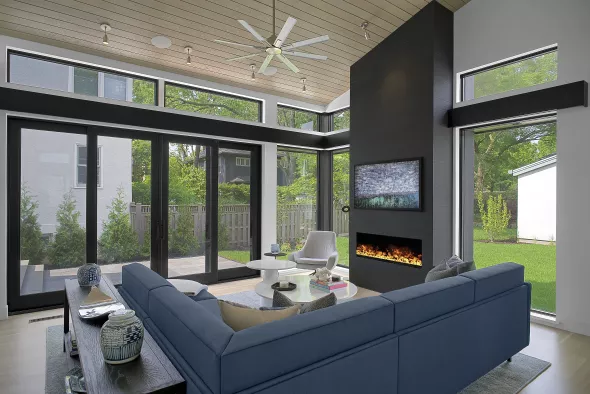
The intentionally modern and minimalist design reflects the owners’ wishes, while also establishing a strong connection to the outdoors. Phius passive building principles guided the careful orientation and sizing of windows, which maximize natural daylight while controlling heat gain. Vertical window placement near perpendicular walls allows daylight to re-reflect deep into interior spaces. A light shelf, which admits the low winter sun while shading the high summer sun, reflects midday daylight up onto the asymmetrical family room ceiling and serves as a horizontal design element linking inside and outside.
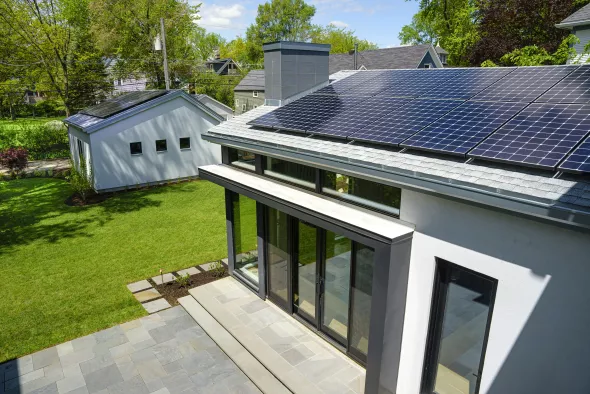
The home’s airtight envelope, combined with a 12.6 kW solar PV array and a battery back up system, enables net-positive performance on an annual basis. A May 2025 utility bill showed an electrical charge of just one cent, followed by a $100 credit in June, even with peak air-conditioning use. This demonstrates that net-zero energy design is achievable in the Midwest without compromising comfort or quality.
Oversized gutters, hurricane straps, a raised foundation, and elevated mechanical and electrical equipment further enhance resilience.
The home was completed on Earth Day 2024, aligning with the vision of a sustainable milestone and a timely move-in date.
This home is a model for the next generation of sustainable living. It is resilient, energy-positive, contextually sensitive, and deeply personal. Every design decision, from “right sizing” the home to reducing concrete and carbon impacts, to universal accessibility and optimized daylighting, demonstrates that sustainability and beauty can exist in harmony.