This blog post addresses the technical challenges of incorporating ducted range exhaust into Phius Certified multifamily passive building projects while maintaining both energy efficiency and indoor air quality.
The Challenge: Balancing Efficiency and Indoor Air Quality
Passive buildings maximize energy efficiency through heat recovery ventilation, which extracts energy from exhaust air and transfers it to incoming fresh air. This strategy works well with relatively clean exhaust streams. However, kitchen range exhaust presents a unique challenge — it contains grease particles that make energy recovery both difficult and potentially hazardous because of fire risk.
Traditionally, passive building practitioners have addressed this issue by:
Using recirculating range hoods to keep kitchen exhaust within the building
Providing continuous kitchen exhaust with a register located away from the range to minimize grease entering the ERV
Installing grease filters on the exhaust stream
Continuous kitchen exhaust rates have varied by code and passive building standards, typically ranging from 25 CFM to higher rates.
What the Research Shows
Recent research from Lawrence Berkeley National Laboratory¹ and other institutions have revealed significant limitations of recirculating range hoods. Studies demonstrate that unhealthy, carcinogenic particulates released during cooking are far more effectively removed by ducted range hoods that exhaust air directly to the outdoors².
Current recommendations are clear: to optimize indoor air quality, install ducted range hoods with sufficient exhaust capacity (typically 150-200 CFM) to capture and expel cooking contaminants. The geometry should have a deep sump to adequately capture the smoke plume³. Today’s typical recirculating range hoods with mesh grease filters simply don’t provide adequate protection.
The Pressure Balance Problem
This creates a dilemma. How can passive builders maintain both a tight building envelope and high indoor air quality? When exhausting 150-200 CFM intermittently through a range hood, you must find a way to balance building air pressure by introducing an equal amount of outdoor air.
In single-family homes, this is straightforward — install an automatic damper to the HVAC return, interlocked with the hood controls. Some applications may require a fan-powered make-up air unit with optional heating. However, apartment buildings present significantly greater challenges.
Understanding Actual Usage Patterns
To ensure building pressurization remains within acceptable tolerances, Phius has reviewed available research on range hood usage in apartment buildings. The Technical Committee found that only 11-13%⁴ of range hoods in a typical multifamily building operate simultaneously, even during peak cooking hours.
Depending on building size, the number of hoods, and other intermittent exhaust sources, significant make-up air may still be required. Phius has developed a calculator to estimate peak coincident exhaust volumes and whether make up air is required to limit depressurization to 5 Pa. Please see the Phius Intermittent Exhaust Make Up Air Estimator.
Make-Up Air Strategies
The following strategies address make-up air requirements when apartment range hoods are operating. Each approach has distinct advantages and trade-offs. This is not an exhaustive list, but captures some of the more feasible approaches.
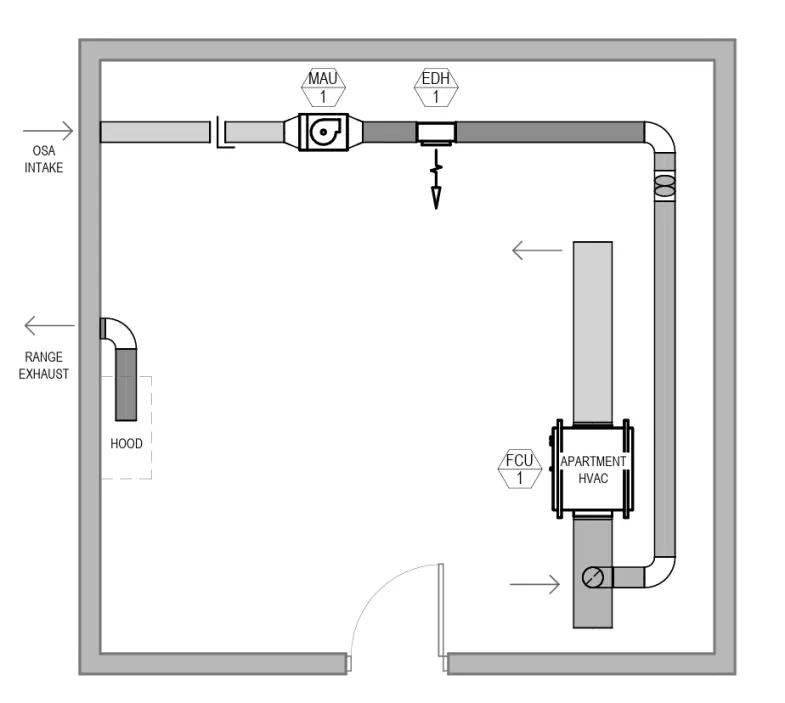
Strategy #1: Direct Outdoor Air to HVAC Return
One option is to provide outdoor air directly to the apartment HVAC unit return. A damper and/or fan — wired to the hood controls — opens or activates when the hood operates.
Advantages
Relatively simple implementation
Works with any ventilation strategy
Drawbacks
Potentially requires upsizing the HVAC equipment to handle the raw outdoor air load (in cold climates, ~6,500 BTU/hr additional heating at 10°F outdoor temperature) potentially doubling heat pump size or more
Adding electric resistance heat to the make-up air fan increases both energy consumption and first cost
Damper and/or fan adds cost
Often requires an additional exterior penetration at each apartment
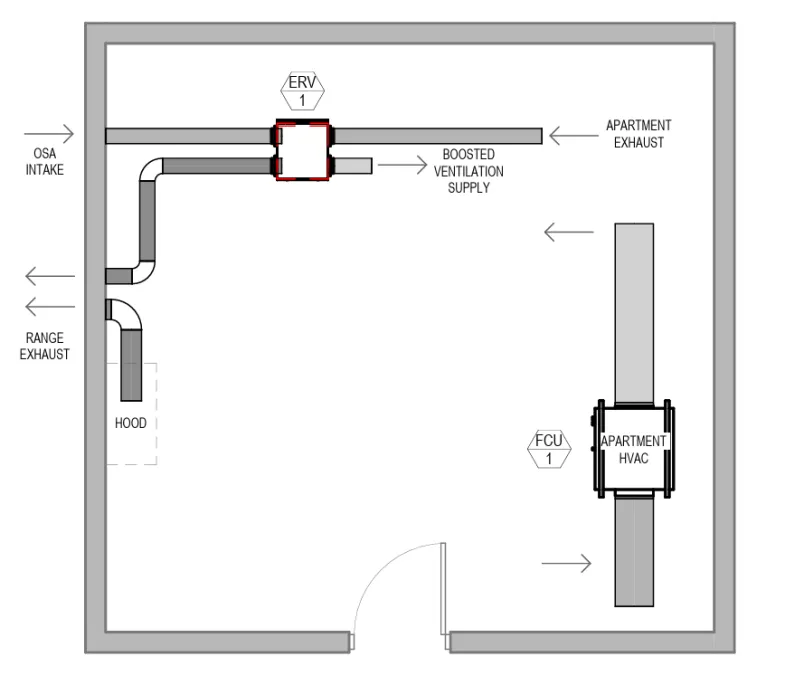
Strategy #2: Individual ERV Boost Mode
Some ERV units can boost supply airflow when signaled that the hood is operating, effectively converting the ERV into a temporary make-up air unit.
Advantages
No additional penetrations required
No additional equipment needed
Drawbacks
Only works with individual apartment ERVs
Increases load on apartment HVAC equipment
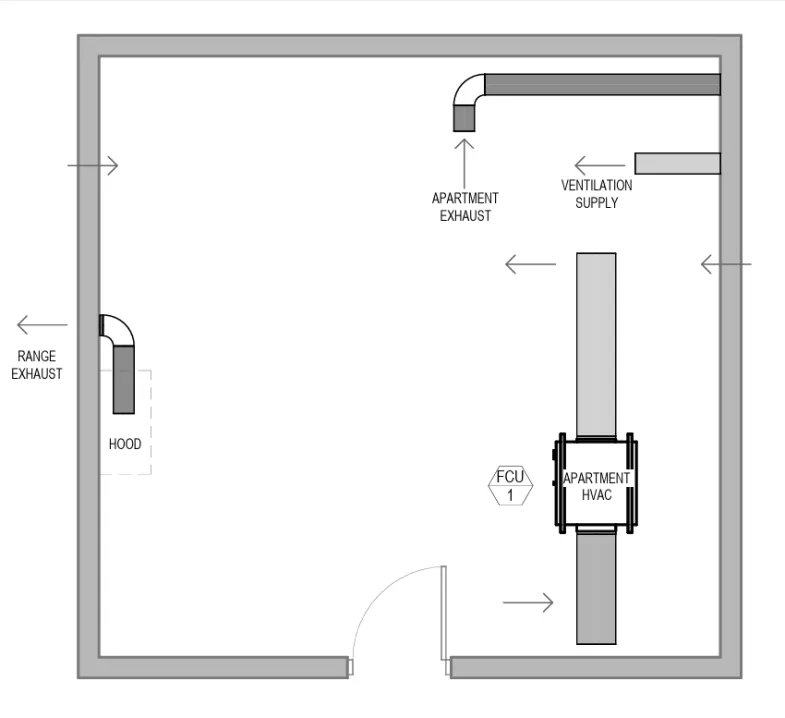
Strategy #3: Whole-Building Slight Pressurization
Based on the calculated make-up air requirement, the entire building can be slightly pressurized by adding more supply air to each apartment and common spaces. When a hood operates, that apartment becomes negatively pressurized relative to outdoors and the corridor, preventing migration of cooking odors and contaminants to other units.
Requirements
Hood must be tested to verify it meets ASHRAE 62.2 minimum requirement of 100 CFM
Advantages
No additional penetrations required
No additional equipment needed
Works with any ventilation strategy
Drawbacks
Difficult to predict where make-up air will come from
Creates temporary pressure imbalances which could lead to air movement between apartments
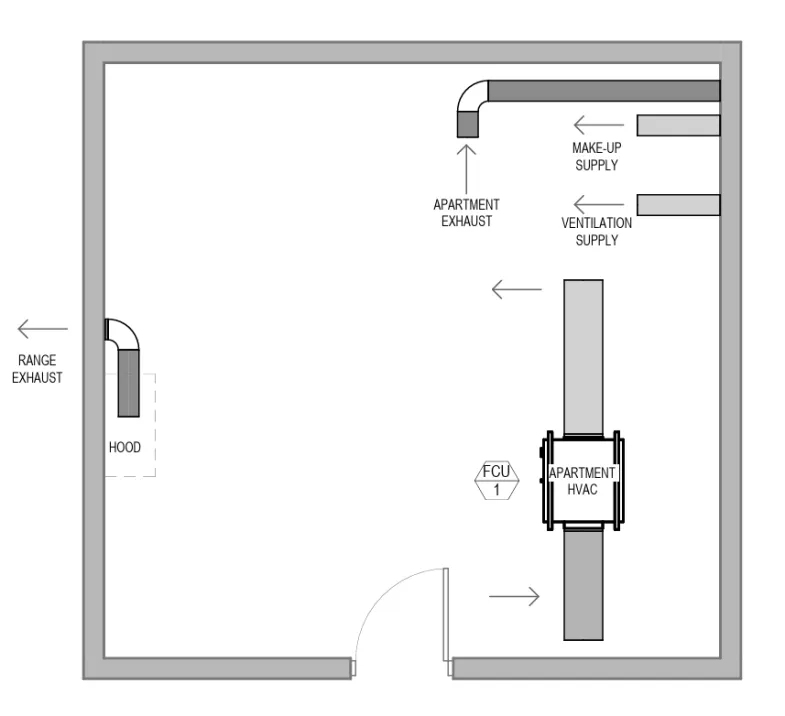
Strategy #4: Dedicated Make-Up Air Duct
A separate make-up air duct from the Dedicated Outdoor Air System (DOAS) can be installed that supplies all apartments. Each apartment receives a backdraft damper in the supply branch. When a hood operates, it draws extra make-up air from the common supply duct.
Advantages
No additional penetrations required
Drawbacks
Requires additional ductwork and dampers, increasing cost
Requires additional space in corridor ceiling cavity
Critical Air Sealing Considerations
Ducted range hoods require exhaust openings in the building envelope. Without proper seals or gaskets, these openings become major sources of air leakage. Various backdraft dampers can be installed either at the building exterior or within the ductwork. However, pressurization and depressurization testing has revealed that many backdraft dampers lack proper sealing and still permit significant air infiltration.
The solution: Specify ducted range hoods with gasketed, well-sealing backdraft dampers. These perform effectively in depressurization tests, preventing nearly all inflow leakage when the ducts are also properly sealed to the exterior facade. This approach allows the building to achieve the critical balance between airtightness and healthy indoor air quality.
In taller buildings, motorized dampers installed in the kitchen exhaust duct may be necessary (open during cooking operations and tightly closed when not in use).
Better Recirculating Hoods
In the future, better recirculating hoods may provide another option. There are several companies that have developed recirculating hoods with high levels of filtration that actually clean kitchen range exhaust to an acceptable level for indoor air quality. This equipment currently comes at a premium, but may still be a good fit for some multifamily passive building projects.
¹Iain Walker and Ines Rojas, “Comparing Extracting and Recirculating Residential Kitchen Range Hoods for the Use in High Energy Efficient Housing,” AIVC Conference, 2017.
²Catherine O’Leary and Benjamin Jones, “A Method to Measure Emission Rates of PM2.5s from Cooking,” AIVC, June 17, 2018.
³Brett C. Singer, William W. Delp, Paul N. Price, and Max G. Apte, “Performance of Installed Cooking Exhaust Devices,” Indoor Air 22, no. 3 (2012): 224–234, https://doi.org/10.1111/j.1600-0668.2011.00756.x.
⁴Mullen, Nasim A., Li, Jina, and Singer, Brett C., "Impact of Natural Gas Appliances on Pollutant Levels in California Homes," (2012), https://doi.org/10.2172/1163521