Phius Co-Founder & Co-Executive Director Katrin Klingenberg examines the value proposition of building resilience within the context of recent severe storms in Chicagoland.
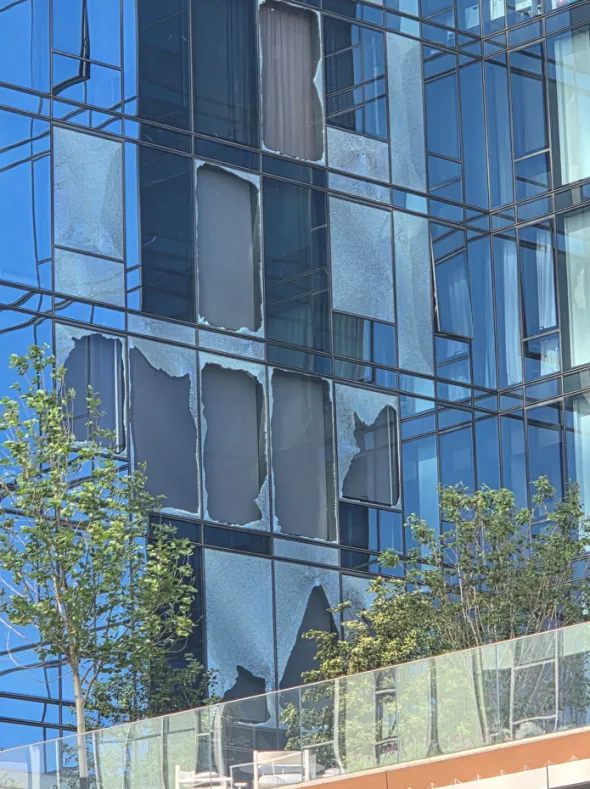
After yet another severe storm swept through Chicago recently, social media quickly filled with photos of shattered glass from a brand-new residential tower on South Michigan Avenue. Curious what actually happened, I walked down there to see it for myself.
Standing beneath the building, camera in hand, I was struck by something that most of the online discussion had missed. The exterior tempered panes shattered spectacularly, scattering thousands of tiny glass fragments below, but the insulated glazing units remained largely intact. The interior panes were still in place.
One social media comment declared, "They must have installed a cheap curtain wall." Looking at the building in person, I came away with almost the opposite conclusion. The façade appeared to have done exactly what it was designed to do. That distinction matters.
As our climate changes, we need to rethink what success looks like in our buildings. For decades we judged buildings by how they looked on sunny days. Increasingly, we will judge them by how they perform on the worst days.
Chicago has now experienced multiple severe storm events in rapid succession. At nearly the same time, much of Europe experienced an extraordinary June heat dome. Temperatures more typical of Northern Africa spread across France, Germany and the United Kingdom. Perhaps more significant than the daytime highs were the tropical nights, when buildings no longer had the opportunity to cool naturally. Passive night flushing — a strategy that has been effective for generations — simply stopped working.
These events are connected. Heat domes store enormous amounts of atmospheric energy. As they begin to break down, the warmer atmosphere holds more moisture, creating the conditions for increasingly severe thunderstorms and, potentially, derechos — fast-moving windstorms capable of producing hurricane-force winds across hundreds of miles. Chicago's recent storms and Europe's unusual heat are different expressions of the same increasingly energetic climate system.
Modern building codes are responding. Design wind pressures for façades have increased, and curtain wall and window wall systems are engineered for substantially greater loads than many older buildings were ever designed to withstand.
Modern curtain wall and window wall systems are carefully engineered assemblies, not simply large sheets of glass. Depending on location and code requirements, exterior glazing may be tempered, heat-strengthened, laminated, or a combination of these. Local building codes commonly require safety glazing for occupant protection and, in many situations, enhanced resistance to wind loads and impact.
Tempered glass is intentionally designed to fracture into thousands of small pieces rather than dangerous shards. Heat-strengthened glass offers greater resistance to thermal stresses, while laminated glass uses an interlayer to retain broken fragments and help maintain the building envelope after fracture. Engineers choose among these solutions based on expected hazards and performance objectives.
In other words, not all broken glass represents failure. Sometimes it is evidence that a carefully engineered sacrificial component performed exactly as intended. In engineering, we routinely sacrifice one component to protect the larger system. Automobiles have crumple zones, electrical systems have fuses, and our buildings are increasingly incorporating similar thinking.
Unfortunately, the greater challenge lies elsewhere. Chicago's skyline is filled with thousands of existing high-rises that were designed under very different assumptions about wind, weather, and climate risk. Many condominium associations understandably postpone expensive façade upgrades because the existing windows still appear to work. But the definition of working is changing.
The insurance industry is beginning to recognize that change. Across many regions, insurers are reevaluating weather-related risks, increasing premiums, or withdrawing from markets altogether. Resilience is becoming far more than an engineering issue. It is becoming an economic one.
I believe one of the largest real estate opportunities of the coming decades is quietly emerging. Buildings that demonstrate resilience through superior envelopes, upgraded façades, passive survivability, moisture management, and climate-adapted design will increasingly differentiate themselves in the marketplace. Those characteristics are likely to matter not only to occupants but also to insurers, lenders, investors and buyers.
For years we have discussed high-performance buildings primarily in terms of energy efficiency and carbon reduction. Those benefits remain essential. But resilience adds an entirely new value proposition: protecting life, preserving assets, enabling rapid recovery, and maintaining long-term value in an increasingly volatile climate.
I left South Michigan Avenue that afternoon with my photographs, but one thought stayed with me. The shattered glass wasn't the story. The story was that someone anticipated a more volatile future and designed a building to meet it.
We cannot prevent every storm, every heat dome, or every derecho that climate change will bring. But we can decide whether our buildings belong to yesterday's climate or tomorrow's. That choice will increasingly determine not only how safely we live, but also which buildings remain desirable, insurable, and valuable in the decades ahead.
Resilience is no longer simply about surviving disasters. It is rapidly becoming one of the defining characteristics of high-value real estate in a changing climate.
A New Climate Economy
For decades, real estate has been valued primarily by location, amenities, and operating costs. Climate is quietly becoming a fourth dimension of value. As extreme weather becomes more common, the market will increasingly differentiate between buildings that were designed for yesterday's climate and those prepared for tomorrow's.
Buildings that demonstrate measurable resilience through high-performance building envelopes, upgraded façades, passive survivability, moisture robustness, and climate-adapted design are likely to distinguish themselves from comparable properties that remain vulnerable. These characteristics will matter not only to occupants, but also to insurers, lenders, investors, and buyers. In that sense, resilience is becoming investable.
This is why I remain optimistic. We already possess much of the science, engineering, and technology needed to adapt our buildings to a changing climate. The opportunity before us is not simply to repair storm damage after it occurs, but to thoughtfully retrofit our existing buildings and design new ones that anticipate tomorrow's conditions. Building science is no longer only about saving energy. It is about protecting lives, preserving communities and creating long-term economic value.