Our monthly Project Spotlights highlight the cutting-edge work being done by Phius professionals and provide examples of successful design and construction strategies. We feature projects of various sizes, typologies, and climate zones, offering you a peek behind the curtain of each.
The clients for the project – avid hikers and bikers – were called to Durham for its natural beauty and dreamt of finding an old farmhouse to renovate. They rented a barn on a historic property and quickly abandoned their vision after watching the owner invest exorbitant time and money in modernizing the main house. Rather than restore an heirloom, they chose to build a new legacy with a Phius Source Zero home.
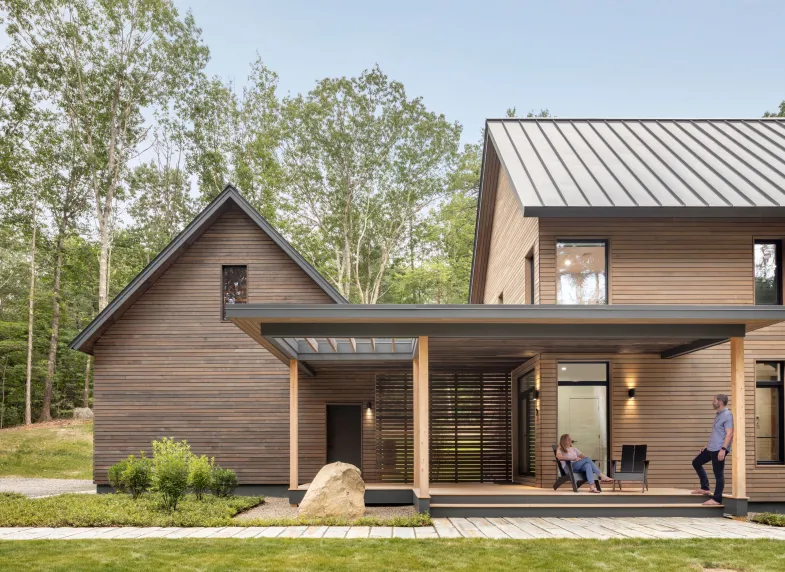
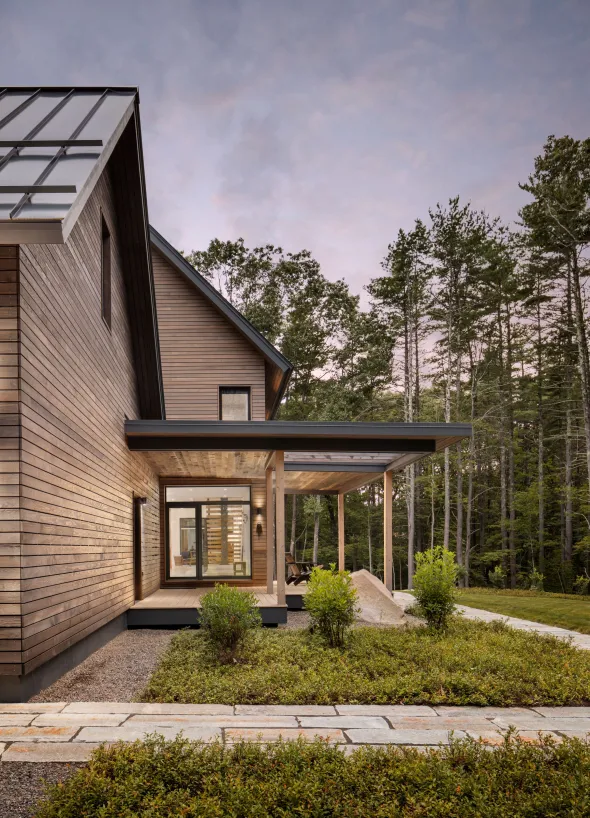
Spark Side sits on 2.8 wooded acres bisected by an old stone wall. Approaching from the northeast edge of the property, the house emerges solid and modest. Gabled volumes recall New England’s colonial architecture and embrace rectangular forms, both for their vernacular aspect and the efficiencies in performance they afford. A detached, barn-like garage connects to the farmhouse porch via slatted breezeway. Sunlight filters through a trellised cutout on the roof to dance across a massive boulder that sits beneath it. Harvested from the site and rolled into place, the monolith pays homage to the wall for which it once served as a cornerstone.
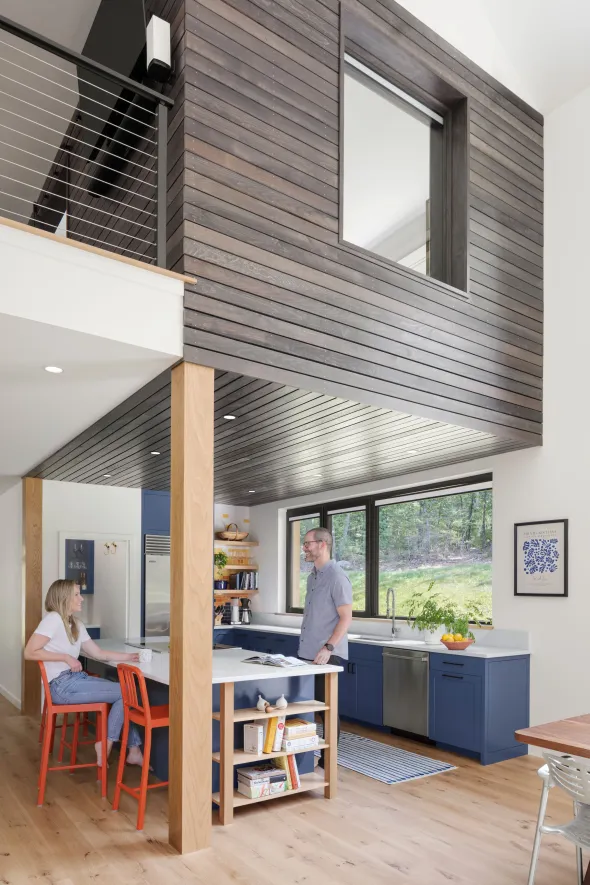
A glassy entryway provides a hint of the modern interior beyond, where south-facing windows flood the double-height dining and living spaces with light and passive warmth. Three bedrooms and three bathrooms round out the home’s 2,921 conditioned square feet, with a workout room and offices below. The double-stud walls are packed with twelve inches of cellulose insulation and clad in local gapped pine that extends indoors to wrap the primary bedroom suite.
Biophilic design guided Spark Side’s detailing and inspired inclusion of a “risk and peril” element in its floorplan. A cantilevered loft extension on the second floor, supported only by 2.5 inch laminated structural boards, jets over the main living area, evoking a bit of the same rush felt when peering down from a cliff’s edge.
As a Phius+ 2018 Source Zero Certified building, Spark Side requires 90% less energy to heat and cool than a code-built home of the same size and is achieving net-zero energy on an annual basis with help from a 12.4KW photovoltaic array.
Digging Deeper
Spark Side achieves Phius+ 2018 Source Zero certification via a right-sized photovoltaic system, airtight construction, and efficient, all-electric mechanical systems and appliances. The wood-framed, double-stud wall assembly is super-insulated with 12” of dense-packed, dry-blown cellulose and constructed to an air-tightness level of 0.25 ACH50. A self-ventilating façade with a Declare-listed Intello Plus Pro Clima vapor retarder protects the assembly from moisture.
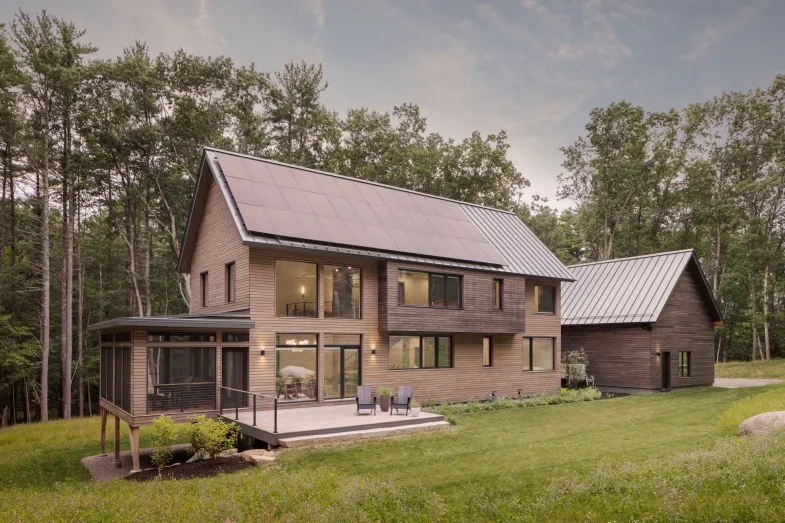
The project site provides optimal south-facing exposure for the home, but in a direction almost 90 degrees off the primary drainage plane. The building cuts diagonally across the sloping terrain to create a facade long enough to capitalize on the sun's bounty; one end of the home anchored on grade, the other walking down the hillside to create a walkout basement condition beneath an elevated screened porch. The lengthy south-facing elevation is as open as the north-facing side is protected, with most of the windows concentrated on the facade where they will work the best.
A 34-panel, 12.4W rooftop REC 365-watt N-PEAK 2 photovoltaic array caps the south-facing gable, generating enough electricity for the site to achieve net-zero energy on an annual basis without the use of fossil fuels. Energy demands are reduced by Mitsubishi cold-climate air source heat pumps, Zehnder Q450 energy-recovery ventilation (120 CFM, site-tested efficiency of 83%), a heat pump hot water heater, 100% LED lighting on both the interior and exterior of the building, and an induction cooktop by Wolf. The home boasts a calculated operational emissions reduction of 10.8 tons of CO2 per year.