More than 650 buildings have earned Phius Certification, and behind each one is a project team deepening their passive building experience and a Phius certification team refining its processes. The hope has long been that these developments, coupled with the continued expansion of the Phius certification staff, would decrease the time it takes to bring a project through the Phius Certification process.
The thought process is that as the number of Phius projects increases, the construction professionals involved in designing and building them (architects, engineers and builders) presumably become more experienced. This experience includes mastering new construction techniques and requirements such as robust air sealing (five times more stringent than the code requirement), exterior insulation and the design and installation of heat (or energy) recovery ventilators.
The expedition of the Phius Certification process is particularly important in a state such as Massachusetts where Phius Certification is one of the two pathways to receiving a Certificate of Occupancy for most multifamily buildings in roughly 50 jurisdictions, including Boston. While many factors can affect completion time, our hope has long been that the time between registration and final Certification of a Phius project would diminish over time.
And now we have more than just hope — we have data.
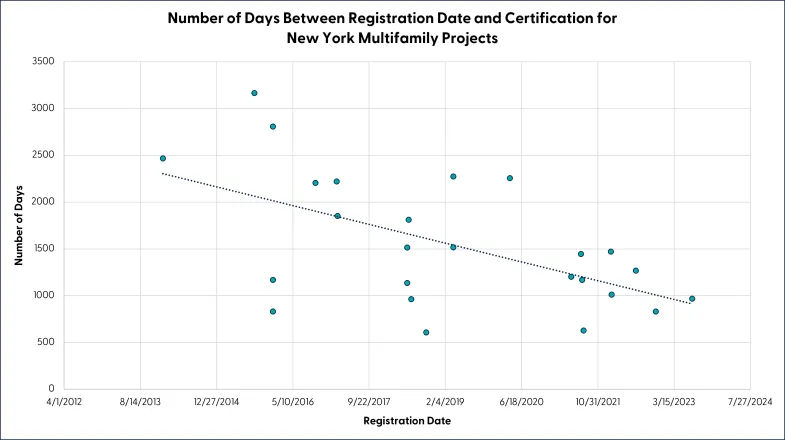
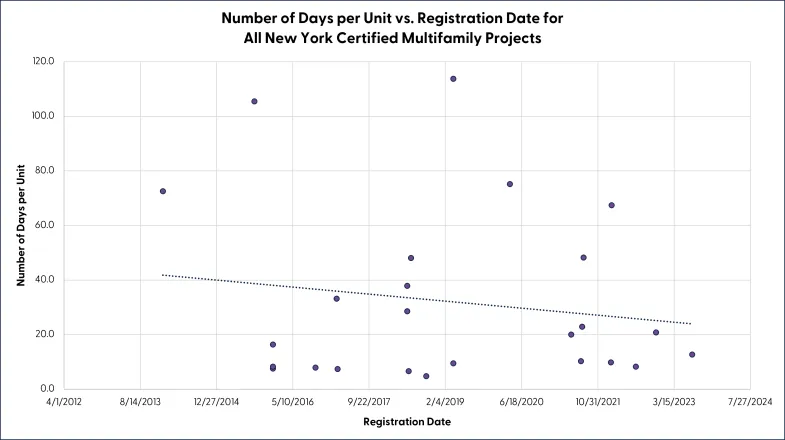
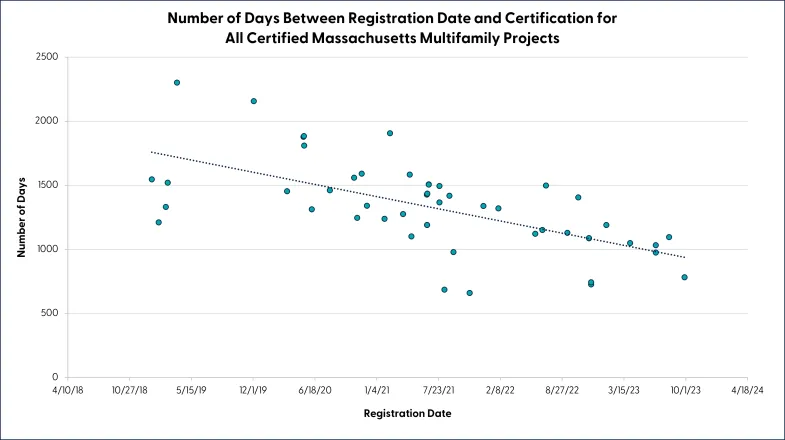
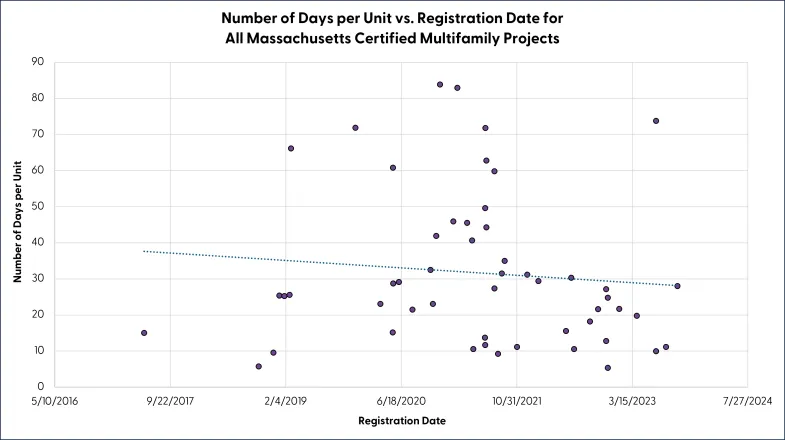
Phius reviewed the completion time of Phius Certified multifamily buildings (20 dwelling units and greater) in New York and Massachusetts, comprising a total of 24 buildings in New York state and 52 buildings in Massachusetts. Note: this took in a wide range of dwelling units. The number of dwelling units of the buildings ranged from 20 to 277 in New York and 28 to 142 in Massachusetts.
The following charts compare the time (in days) between the registration date and date of Phius Certification for multifamily buildings in Massachusetts and New York for two conditions. The first is based on the total dwellings in the building and the second, to control for size, measures the number of days per unit.
Conclusion
Based on the four graphs shown above, there is a definite downward trend in the number of days to receive Phius Certification as the registration date gets closer to the present. Again, this is to be expected based on the increasing ability of the construction professionals (and the time for certification reviews themselves). The trend is less pronounced when the data is normalized for building size, but the downward trendline is maintained.
These charts provide early evidence that construction experience on Phius projects results in reduced certification time, and we will continue to monitor this data to ensure this trend continues.