Our monthly Project Spotlights highlight the cutting-edge work being done by Phius professionals and provide examples of successful design and construction strategies. We feature projects of various sizes, typologies, and climate zones, offering you a peek behind the curtain of each.
CPHC: Daniel Luddy, CPHC / PAE Consulting Engineers
Builder: Exxel Pacific, Inc.
QA/QC: Chris Edlin / O'Brien360
Owner/Developer: The Bush School
An Inside Look
Founded in 1924 by Helen Taylor Bush, the independent school enrolls more than 700 students in grades K-12, with a 42% BIPOC population. The upper school campus is located across Lake Washington Boulevard and up a steep slope from the lower campus.
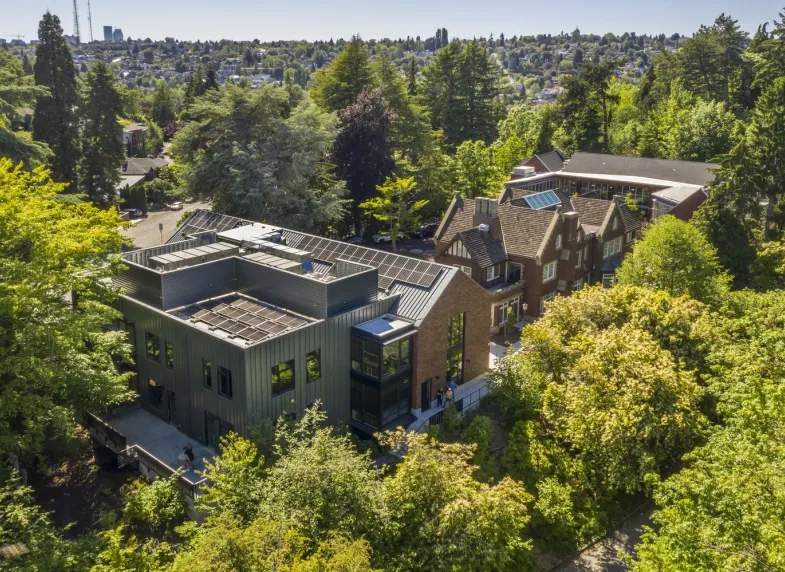
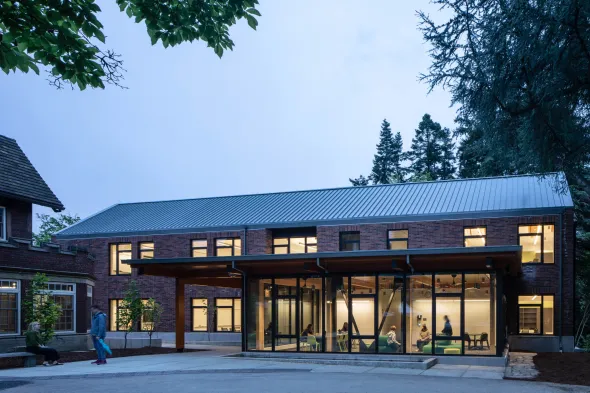
This project expanded the existing upper school campus on a tight infill site to provide additional classrooms and informal gathering spaces for grades 9-12, as well as multipurpose assembly space for the entire school community.
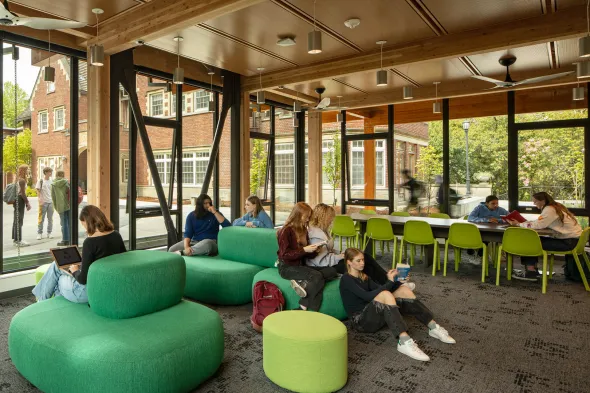
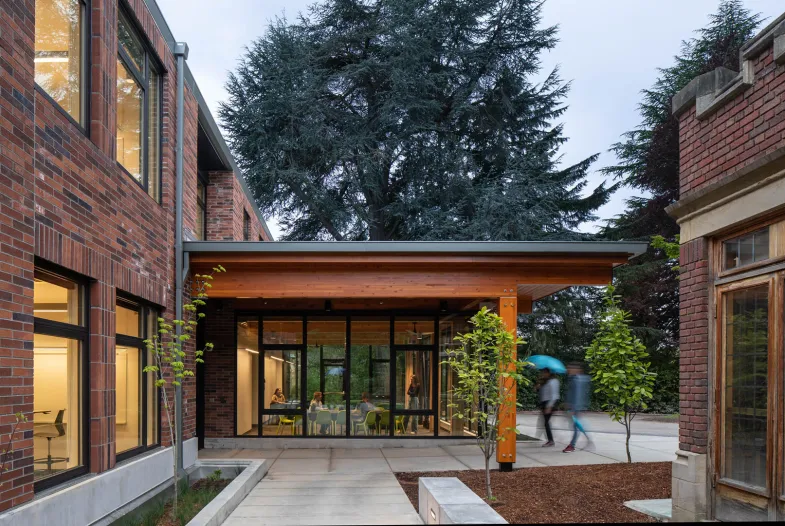
Early vision workshops revealed a clear goal of demonstrating actionable climate solutions to both students and the broader community. Guided by these aspirations, the integrated design team approached this sensitive site with utmost care and respect to harmonize the building’s functional and educational space needs with equal importance while avoiding steep slopes and preserving significant existing trees. Close collaboration with the contractor and the mechanical, electrical, and envelope design consultants was essential to ensure optimal thermal energy performance, cost efficiency, and construction sequence. Thoughtful material selections, superior air quality with an above-code volume of filtered outdoor air, and seamless indoor-outdoor connections foster an environment that nurtures well-being.
The result is a comprehensive, multifaceted solution that drives meaningful social, economic and environmental benefits, which ultimately provided a path to achieve Phius, Zero Energy, and Salmon Safe certifications. This holistic approach not only enhances sustainability but also showcases a powerful precedent for responsible stewardship and long-term positive impact.
Digging Deeper
The optimized building enclosure reduces peak energy load down to 4.3 BTU/hr.sf for heating and 1.3 BTU/hr.sf for cooling, ensuring a grid-friendly building and resilience in the future. Triple-pane windows, 90% heat recovery ventilation and an airtight/smoke-tight envelope minimize heat loss and gain. Dedicated Outdoor Air Supply (DOAS) delivers above-code level ventilation air (4 to 5 ACH) with MERV-13 filtration, providing exceptional comfort and health.
This all-electric design avoids a VRF system, with high GWP refrigerant leakage potential, instead using air-source heat pumps with a two-pipe changeover system, which must avoid conditions of simultaneous heating and cooling to be successful. Estimated annual energy use was 22 EUI and measured 23 EUI, 50% less than a code minimum building and 70% below the AIA 2030 Commitment national baseline. A 163 kW PV array, 18 kW from the building rooftop and 145 kW on the roofs of two other school buildings, generates 3.4% more energy annually (measured) than the building uses. The building rooftop has a small footprint, largely covered by mechanical systems and is partially shaded from the surrounding existing trees. This rooftop also incorporates space for mechanical equipment that serves the adjacent historic Gracemont Hall as part of its renovation, modernization and electrification.
School projects have diverse hours of operation and varying use intensity. This design includes a warming kitchen and multipurpose space for after-school programs and events, variables which are difficult to predict in energy models. To account for this, a year-round operation schedule of 7 a.m. to 10 p.m., with peak hours between 8 a.m. and 5 p.m., was included in modelling to provide a buffer above expected use. Measured results showed winter energy use at 7% lower than modelled and summer energy use, especially June with year-end events, higher than modeled.
To verify thermal comfort for occupants in the summer months, the design team used future 2050 climate estimates for the region to assess comfort levels. Through this analysis, the team was able to recommend a partially cooled building with operable windows and ceiling fans to supplement. The building was also modeled for passive survivability, having no power while modeling the exact conditions of the 2021 heat dome with three days above 100 degrees peaking at 108 degrees. Under that extreme stress, the interior heat index stayed below 90 degrees.